GeoCities.us
» Athens » Academy
|
GeoCities.us
» Athens » Academy |
Get your FREE home page! |
 |

Room 7 HatchCam
Ten eggs. Twenty-four third graders. Twenty-one days.
HATCH DAY IS TUESDAY, SEPTEMBER 28!
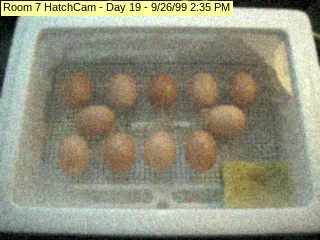
Today, Sunday, September 26, 1999, is Day 19. Watch with us all weekend!The camera sends a new picture every five minutes, day and night, weekends too.
This page reloads itself every five minutes. If the picture looks stuck, press Reload.
What you are looking at
You are looking straight down through the window in the lid of our incubator. It is a plain white styrofoam box about a foot and a half square, with a heater in the lid and no fan (that's called a "still-air" incubator). The ten brown eggs are lying on a wire floor. Under the wire are little channels of water that keep the air damp. The skinny line among the eggs is our thermometer. We keep it at about 101½ degrees right at the top of the eggs, the same as under a mother hen.
Every egg has a small pencil X on one side. Until yesterday we turned the eggs by hand three times a day, at 8:30, 11:45 and 3:00, X up and then X down, so the chick inside would not stick to the shell. The yellow thing in the corner is a wet sponge. It went in yesterday to make the air extra damp for hatching.
The camera is the school's Kodak DVC323, clamped to a ring stand we borrowed from the science closet. It plugs into our classroom computer, and a shareware program called Webcam32 sends the picture to this page. A little lamp with a 25-watt bulb shines on the window from one side so you can see at night. (We checked first. It does not change the temperature in the incubator.)
Where our eggs came from
Leo and Patsy Mullenax keep a flock of laying hens on their farm north of Topeka, and this fall they had fertile eggs to spare. Mrs. Mullenax brought us twelve on Tuesday morning, September 7, wrapped in a towel in an egg carton. They are a mix of two breeds, Barred Plymouth Rocks and Rhode Island Reds. Both lay brown eggs, so we won't know who is who until they hatch!
Our 21-Day Calendar
Written up by Room 7 at the end of each school day. Weekend notes are from Mrs. Beard.
Day Date What happened 0 Tue 9/7 Twelve eggs arrived! We let them warm up to room temperature, marked each one with an X, and set them in the incubator at 1:15. 1 Wed 9/8 First turning day. The thermometer stayed at 101½ all day. We made a turning chart for the door. 2 Thu 9/9 We learned the yolk is not the chick. The yolk is the chick's food. 3 Fri 9/10 Added warm water to the channels. Mrs. Beard took the turning chart home for the weekend. 4-5 Sat-Sun Mrs. Beard came in three times each day to turn the eggs. Mr. Julius, our custodian, let her in on Sunday. 6 Mon 9/13 We drew pictures of what we think is inside. Most of us drew a whole chicken. (Not yet!) 7 Tue 9/14 CANDLING! We took the eggs one at a time into the dark coat closet and shined a flashlight through them. Ten eggs had red veins like spider legs and a dark spot in the middle. Two eggs were clear, with nothing growing, so they came out. Ten left. 8 Wed 9/15 We read that the chick's heart is already beating. 9 Thu 9/16 The sun came in the window after lunch and the thermometer went up to 103. We closed the blinds and it came back down. Now the blinds stay shut. 10 Fri 9/17 Almost halfway! We guessed how many will hatch. Guesses went from 4 to 10. 11-12 Sat-Sun Weekend turning. Seven Room 7 families e-mailed to say they were watching the HatchCam. Hello! 13 Mon 9/20 We graphed our temperature readings. The line is pretty flat, which is good. 14 Tue 9/21 Candled again. All ten are growing. The eggs are mostly dark now, the air space at the big end is bigger, and in one egg we saw a shadow MOVE. 15 Wed 9/22 We wrote thank-you letters to Mr. and Mrs. Mullenax. 16 Thu 9/23 Library day. We checked out every chicken book they had. 17 Fri 9/24 Our last turning in class. We practiced whispering around the incubator. 18 Sat 9/25 LOCKDOWN. No more turning. The chicks need to get into hatching position. Mrs. Beard added the wet sponge for extra humidity. The lid stays closed now until the chicks are hatched and dry. 19 Sun 9/26 Today. The eggs are resting. If you watch long enough, you might catch one rocking. 20 Mon 9/27 Listen for peeping inside the shells! The first pips could come tonight. 21 Tue 9/28 HATCH DAY! Some chicks come a day early and some a day late, so keep watching on Wednesday too.
Pipping and zipping
Just before hatching, the chick pokes its beak into the air space at the big end of the egg and takes its first breath. Then it uses a tiny bump on the tip of its beak, called the egg tooth, to break a small hole in the shell. That first little hole is the pip.
After pipping, the chick rests, sometimes for many hours. Then it starts turning inside the shell and chipping a line all the way around the big end. That's zipping. When the line goes around, the chick pushes with its legs and the cap pops off. Out comes a wet, tired, not very pretty chick. It dries into a fluffy one in a few hours.
A note for worried watchers: a chick can take a long time from pip to hatch, and that is normal. We will not help any chick out of its shell. Helping can tear blood vessels the chick still needs. The chicks know how to do this.
Egg-to-Chick Facts Room 7 Learned
- A chicken egg takes about 21 days to hatch. A duck egg takes about 28.
- An eggshell has thousands of tiny holes called pores. Air goes in and out through them, so the chick can breathe.
- The air space at the big end of the egg gets bigger as the egg gets older.
- Just before it hatches, the chick pulls the rest of the yolk into its belly. That is its food for the first day or two, so it doesn't need to eat or drink right away.
- The egg tooth falls off a few days after hatching.
- A mother hen turns her eggs with her beak many times a day. We only turned ours three times, and that is enough.
- Barred Rock chicks hatch black with a pale belly and a little white spot on top of their heads. Rhode Island Red chicks hatch reddish tan.
- Baby chicks can't keep themselves warm yet. They need a heat lamp, about 95 degrees the first week, then five degrees less each week.
Where the chicks go afterward
After hatching, the chicks will stay in Room 7 for about a week in a big cardboard box with a heat lamp, pine shavings, a feeder and a waterer. Then Mrs. Mullenax will take them home to the farm, where they will grow up with her flock. The hens should start laying next spring, and she has promised Room 7 a dozen of their eggs.
See two pictures from last April's hatch, with our first HatchCam chicks.
Room 7 families: you are welcome to check the HatchCam from home or from work, as often as you like. Please send questions to me by e-mail rather than calling the office. On hatch day the class will post a note on this page after each new chick.
You are visitor number
since the HatchCam started in April 1999Mrs. Melanie Beard, Room 7
Last updated Sunday, September 26, 1999
[email protected]