GeoCities.us
» Baja » Trail
|
GeoCities.us
» Baja » Trail |
Get your FREE home page! |
 |

|
Five single people on a mountain on Valentine's Day. That was the joke at the office all week, and my officemates did not let it go. While half of Manila was lining up for roses and dinner, the five of us were on a night bus to Baguio with our backpacks, going to sit in the cold on top of Luzon and wait for the sun. It was the best Valentine's Day I've ever had, and nobody even gave me chocolate. (Nelson gave me a candy bar on the summit. It was half frozen. I'm counting it.) For those who don't know me: I'm Gerald, 27, a civil engineer with a construction company in Pasig. I still live with my parents in Marikina, which my mother says is fine as long as I stop leaving muddy shoes on the porch. I've climbed with the Talampas Mountaineers since 1995. We're a small weekend club in Manila, mostly office people who spend the week in traffic and the weekend going up something. Talampas means plateau, which is funny, because a plateau is the one thing we never get to walk on. It's always up. Pulag was our big climb this year, and I promised the others a write-up with times. I'm an engineer. Of course there are times. I put this page up in March, and I keep adding to it as people write in with questions. The question I get most is "How cold is it, really?" The answer is below. It's colder than you think. |
MT. PULAG, IN SHORT
|
|
^ THE FIVE OF US Abby Lim, 24, a nurse. The fastest of us, by a mile. She also carries the first-aid kit, so if you can't keep up with her you're on your own. When Abby says "Malapit na" (almost there), add one hour. Mel Palma, 28, an accountant and the club's treasurer. Mel keeps the money, keeps the gear list and keeps us honest. She's Ate Mel to me, since she's a year older, and she won't let me forget it. Her famous list is on its own page: Mel's Gear List. Nelson Lacsamana, 25, the club's cook. Nelson will carry a pot up any mountain in the Philippines. Best sinigang I've had on any mountain, and possibly anywhere. Gilbert Manalang, 25, on his first big climb. Borrowed an orange windbreaker. Asked "Malayo pa?" (Is it still far?) eleven times between the ranger station and camp. I counted. Me. I carried a tent and the camera, which means I'm in none of the pictures. That's the price of owning the camera. And Manong Rodel, our guide from the ranger station, who never once looked tired and always knew where to stop us for the view. ^ THE ITINERARY People ask for distances. I don't have a measured distance for the trail, and I'm not going to guess at one, so I'll give it the way climbers do, in hours. All times are from my watch. |
| DAY | TIME | WHAT |
| Fri Feb 12 | 10:00 p.m. | Night bus, Manila to Baguio |
| Sat Feb 13 | about 4:00 a.m. | Baguio, after about six hours. Coffee and pandesal |
| 6:00 a.m. | Hired jeepney leaves Baguio, packs on the roof | |
| 9:30 a.m. | Ranger station at Ambangeg. Registration, orientation | |
| 10:30 a.m. | Start up the Ambangeg trail, through the pines | |
| 12:00 noon | Mossy forest. Lunch on the trail | |
| 3:00 p.m. | Campsite in the grassland. Tents up fast | |
| 6:00 p.m. | Supper: Nelson's sinigang | |
| 8:00 p.m. | Everyone in their sleeping bags. Nobody argued | |
| Sun Feb 14 | 3:30 a.m. | Up. Coffee |
| 4:00 a.m. | My thermometer reads 3 degrees | |
| 4:45 a.m. | Leave camp for the summit, by flashlight | |
| 5:45 a.m. | Summit | |
| about 6:20 a.m. | Sunrise over the sea of clouds | |
| 7:00 a.m. | Back down to camp. Breakfast, break camp | |
| 8:15 a.m. | Start down through the grassland | |
| 11:00 a.m. | Ranger station. Sign out | |
| 3:00 p.m. | Baguio. Strawberries at the market | |
| 11:00 p.m. | Bus back to Manila | |
| Mon Feb 15 | 8:00 a.m. | At my desk in Pasig. No sleep |
|
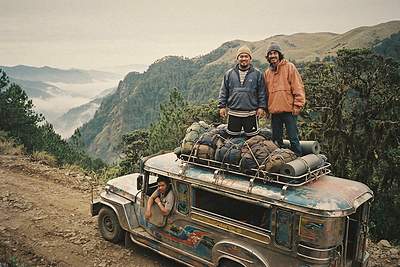
^ FRIDAY, FEBRUARY 12 We met at the bus terminal at nine. Mel was there first, with her list, and she checked every pack before we got on the bus. She does this every climb. She actually opens the packs. Gilbert had packed a pillow. A real pillow, from his bed. Mel made him carry it the whole weekend as a lesson, and by Saturday night everyone wanted to borrow it. The bus left at ten on the dot. The aircon was set to arctic, which turned out to be good training. ^ SATURDAY, FEBRUARY 13 We got into Baguio at about four in the morning, half asleep and already cold, and had coffee and pandesal while we waited. At six our hired jeepney came, and we tied the five packs on the roof. Nelson and Gilbert rode on top with them, "for the view," and also, they said, to hold the packs down. Inside were Abby, Mel, me, the driver, and a great deal of bouncing. It's three and a half hours from Baguio on rough mountain roads, up through pine country. As a civil engineer I have opinions about some of those roads, but I'll keep them to myself, because that driver took his jeep up places I wouldn't take a bulldozer. And the view: pine trees on every ridge, mist lying down in the valleys, and the air getting cooler at every turn.
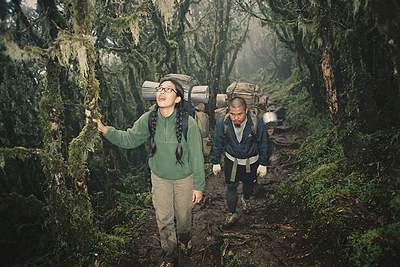
At the ranger station at Ambangeg we registered, paid our fees and sat through the orientation talk with the rangers. Listen to the orientation. I've heard it before, and I still listened. They explain that the mountain is sacred to the Ibaloi and Kalanguya people who live around it, and they ask you, very politely, not to shout and not to litter on the summit. That's not much to ask of a guest. Then they introduced us to Manong Rodel. We started up the Ambangeg trail at about 10:30. Ambangeg is the easiest trail on Pulag, which is why we chose it for Gilbert's first big climb, and it's still a climb. The first part is through Benguet pine: a wide path, dry needles underfoot, and that pine smell that makes you feel healthier just breathing it. Then, around noon, you walk into another world. The mossy forest. The trees get short and twisted, every branch is wrapped in thick green moss, and long pale lichen hangs off everything like an old man's beard. It was cold, and everything was dripping. Mist came through between the trunks. Nobody talked for a while, which for our club is a record.
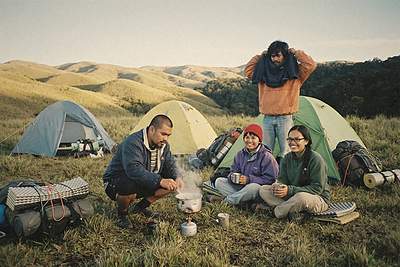
The trail in the mossy forest is mud and roots. Watch your feet. Gilbert's shoes had no grip at all, and he sat down hard twice, once on purpose. I'll be honest, too: the last stretch before camp, my legs were rubber. Abby was waiting for us at every turn, not even breathing hard, eating crackers. We came out of the trees into the open grassland and found the campsite by three o'clock. You feel the wind the moment you leave the forest. We put up the three tents fast, before our fingers stopped working, and then Nelson went to work. Nelson's sinigang, made on a little camp stove with the wind trying its best to blow out the flame, is the best thing I have ever eaten. (I've said that about other things Nelson has cooked on other mountains. It's still true.) Hot and sour, with rice, both hands around the cup for warmth. Gilbert had three helpings and then apologized to everybody.
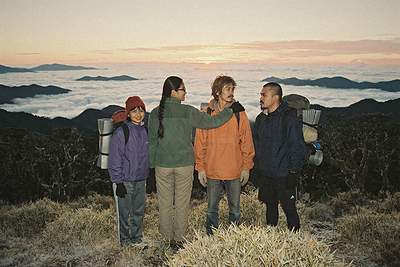
After dark the cold comes down like it's personal. We were all in our sleeping bags by eight, wearing everything we had brought. I had on two pairs of socks, long johns, track pants, two shirts, my fleece, my jacket, a bonnet and gloves, inside my sleeping bag, and I was still cold. Gilbert slept with his pillow. Nobody laughed at the pillow anymore. I keep a little thermometer on my key ring. At 4 a.m. it read 3 degrees. Three degrees Celsius, in the Philippines! You could see your breath inside the tent. Ang lamig! ^ SUNDAY, FEBRUARY 14 Up at 3:30. Nobody wanted to be. Nelson had water boiling for coffee by four (that's when I read the thermometer), and at about 4:45 we started up for the summit, Manong Rodel in front. The last hour is in the dark, up the open grassland, everyone in their own little circle of flashlight. The stars were so thick that Abby kept stopping to look up. It was the only time on the whole trip that Abby stopped for anything. We were on top at 5:45. Then we waited, in the wind, with our hands in our armpits, for the sun. I don't really know how to write the next part. The sky in the east went from black to dark blue to orange, and slowly we could see what was under us. Clouds. A flat white sea of clouds filling every valley as far as we could see, with the dark tops of other mountains sticking out of it like islands. At about 6:20 the sun came up over the far edge, and everything went pink and gold. Nobody said a word. Not Nelson, who never stops talking. Not Gilbert, who had complained about the cold for the whole last hour. We just stood there. Even if the rangers hadn't asked us not to shout on the summit, I don't think any of us could have. It's that kind of place. I've been climbing since 1995, and that was the best sunrise of my life. When we could talk again, I made them line up for the summit picture.
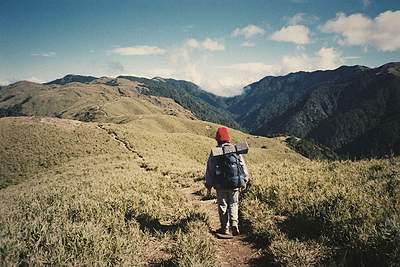
We stayed on top until about seven, when our feet told us it was time. Back down at camp, Nelson made champorado (chocolate rice porridge, for my friends abroad), which is the right breakfast for a cold morning on a mountain. We broke camp, picked up every bit of trash, including two candy wrappers that weren't ours, and started down at about 8:15. Going down, you finally see what you climbed through in the dark: bare rolling ridges of dwarf bamboo, knee-high, pale green and gold, under a sky so blue it almost hurt. Abby was gone almost at once, down the trail ahead of us, with her red bonnet getting smaller and smaller.
We were back at the ranger station by eleven. We signed out, thanked Manong Rodel, and piled back into the jeep. Down in Baguio we went straight to the market for strawberries. Mel bought a kilo for her office. Gilbert bought two kilos and ate one of them on the bus. The only seats we could get were on the 11 p.m. bus. I got home to Marikina at dawn, showered, ate my mother's breakfast, and was at my desk in Pasig at eight sharp on Monday morning, with no sleep at all. My boss asked me how my Valentine's was. I told him I spent it with four friends and a sunrise. He's still trying to work that out. ^ WHAT IT COST Mel kept the books, as always. It came to about P1,200 each, for:
That's without the gear. If you're starting from nothing, the gear will cost you more than the trip, but you can borrow most of it the first time. Gilbert borrowed nearly everything, including the windbreaker. Strawberries not included. ^ THE COLD If you're from the lowlands and own no winter clothes (who does?), read Staying Warm on the gear page before you go. Bonnets, gloves, layers, and where to find a cheap jacket in Baguio. Three degrees is no joke. ^ LEAVE NO TRACE I joke about everything else on this page, but not this. A mountain is not a picnic ground, and Pulag is somebody's sacred mountain. These are our club's rules, and if you climb with us, they're yours too:
^ NEXT CLIMBS
Want to come along? We're a small club, and we're always glad to have new people, as long as they keep the rules above. Mail me and I'll tell you when we meet. And to anyone else heading up Pulag: listen to the rangers, bring more warm clothes than you think you need, and wait for the sun. Ingat! |


 Questions about Pulag, or about the club? [email protected]