 GeoCities.us
» Broadway » Stage
|
GeoCities.us
» Broadway » Stage |
Get your FREE home page! |
 |

 Mae's First Sinulog
|
This page is for my sister and our cousins in the United States and in Italy, who have been asking for the pictures since January, and for anyone else who has never stood on a Cebu street on the third Sunday of January and felt the drums in their ribs. My name is Cecilia Navarro. I teach English at a public high school here in Cebu City. My husband Rey is a checker at a shipping line's office at the pier, and we have two children: Mae, who is sixteen now and in her last year of high school, and Joshua, who is ten and has opinions about everything. Last January, Mae danced in the Sinulog grand parade with her school's dance troupe. It was her first time. I have been to many Sinulogs in my life, but I had never been to one with my own heart dancing down the middle of the street. The first version of this page went up in February with nothing but words, because the scanner belonged to somebody else. A former student of mine, who now knows far more about computers than I ever will, has finally scanned the prints for me. So here, at last, are the pictures, and the whole weekend in order, the way I would tell it to you if you were sitting at our table. 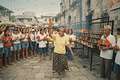
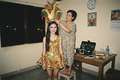
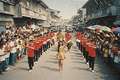
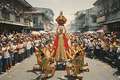

What the Sinulog Is · Sequins in December · Saturday · Sunday Before Dawn · The Parade · Mae's Own Words · Thank You, Sir Ronald · Sinulog 2000 What the Sinulog Is The Sinulog honors the Santo Niño de Cebu, the image of the Child Jesus that was given in 1521. It is the oldest religious image in the Philippines, and it is kept in the Basilica Minore del Santo Niño, with Magellan's Cross standing nearby. Every year, on the third Sunday of January, the whole city comes out for Him. The sinulog dance moves the way the current of a river moves, the current we call sulog: forward and back, forward and back, never quite still. You will see it danced by old women outside the Basilica and by hundreds of students in sequins in the parade, and it is the same dance. And everywhere, the shout: Pit Señor! It comes from sangpit sa Señor, calling on the Lord. People shout it when the drums start, when the Santo Niño passes, when a troupe finishes its dance, and sometimes, I think, simply because they are happy. In Cebu a prayer and a celebration are not two different things. Each school troupe dances a story. Mae's troupe told the story of the first baptism in Cebu in 1521, when the Santo Niño was given to Rajah Humabon's wife, who was baptized Juana. Their festival queen carried a replica of the Santo Niño on a little platform, held high above her head, and the whole dance builds toward that moment. You will see it below. Sequins in December It began in November. The troupe's trainer and choreographer, Sir Ronald Tupas, a P.E. teacher, drilled them every afternoon after class and all day on Saturdays. Mae came home every evening too tired to eat and too excited to sleep, and she practiced the arm movements at supper until Joshua complained that she was dancing into his rice. The mothers sewed the costumes: gold, red and green, every one covered in sequins, with tall headdresses of feathers. I spent most of December at our dining table with Mae's costume, sewing the sequins on one by one after I had graded my students' papers. I would finish the last composition at nine or ten at night, push the stack to one end of the table, pull the costume to the other, and sew until my eyes gave out. By Christmas there were sequins in the rice, sequins in Joshua's hair, sequins in the pocket where I keep my red pen. I am still finding them. Last week one fell out of my dictionary. When it was finished, Rey put the whole costume on the bathroom scale, headdress and all: a little over three kilos. That does not sound like much until you imagine dancing in it for hours in the January sun. The headdress made Mae taller than her father, which she enjoyed more than she should have. Saturday, January 16 Saturday is the day of the processions: the fluvial procession on the water at dawn, and in the afternoon the solemn procession through the streets. Mae spent the day at school for one last practice with Sir Ronald, so Rey, Joshua and I went to the Basilica to light candles for her. Outside the Basilica, women sell candles, and for your intention they will dance the sinulog with them for you. We bought ours from a woman in a yellow shirt. I told her the candles were for my daughter, who would dance in the parade the next day for the first time. She nodded as if she had heard this a thousand times and was glad to hear it once more. Then she lifted the candles, closed her eyes, and danced for Mae, barefoot on the old stones, her lips moving in a prayer that was between her and the Santo Niño. I have seen the candle women all my life. I had never had one dance for my own child. I stood there holding Joshua's hand much too tightly, and he let me. 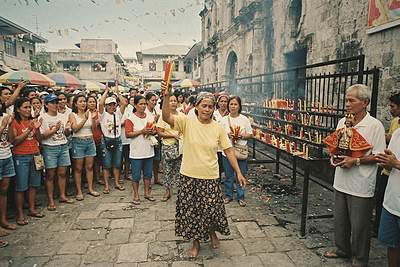 The candle woman dancing for Mae's intention outside the Basilica, Saturday afternoon. Behind her, the iron rack full of burning candles and the old stone wall; beside her, an old man holding up his own small Santo Niño in its red cape. That night I laid everything out on the dining table: the costume, the arm cuffs, the headdress, the makeup, the bobby pins, a bottle of water. Then I set the alarm, and then I set Rey's alarm too, and then I did not sleep. Sunday, January 17, Before Dawn The alarm rang at three. Makeup came first: foundation, bright lipstick, and glitter, which I put on with the same hand that had held a red pen all week, and with much less confidence. Then the costume, then the gold arm cuffs, and last the headdress, which had to be pinned into her hair so firmly that it would survive the whole day. Mae is taller than I am now, so I stood on the little stool, and Rey took the picture. 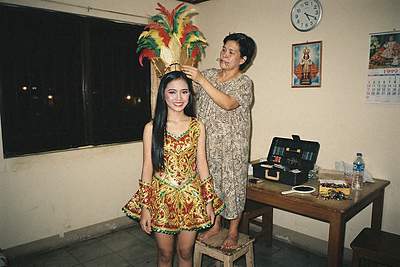 Before dawn in our living room. Mae in her costume, and me on the stool behind her with the headdress. On the wall are our clock, our picture of the Santo Niño and the new 1999 calendar; on the table, the makeup kit, a hand mirror and a bottle of water. The window is still black. Look at her face. She was trying very hard to look calm, and she nearly managed it. I was not trying at all. We heard an early Mass, and then we walked her to where the troupe was gathering. On the way, Mae turned to answer something Joshua said, and the top of her headdress missed a light post by the width of one feather. Rey says it was closer than that. Sir Ronald, who saw it happen, said nothing at all, but I watched the color leave his face. The Parade The grand parade went on from the morning well into the afternoon, in heat that made the street shimmer. We found our place along the route early and kept it, with umbrellas, bottled water and a bag of pan de sal, and we waited, and watched troupe after troupe go by in feathers and sequins, every one of them somebody's child. We heard Mae's troupe before we saw it: the drums first, the boys in their red shirts, a sound you feel in your chest before you hear it with your ears. And then there she was, out in front of the drummers, arms up, hands turning at the wrists, forward and back like the current, concentrating so hard that she never once looked our way, though Joshua screamed her name until the people in front of us turned around to smile at him. 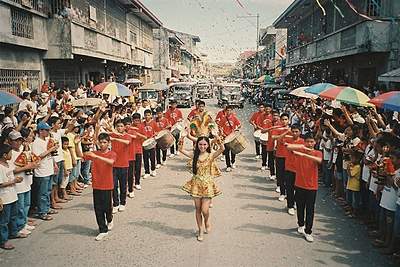 Mae dancing out in front of the drummers, the boys in the red shirts, with the crowd packed along both sides of the street. The rest of the troupe is just outside the picture. I was so busy looking at my daughter that I forgot to step back. And then the moment the whole dance had been building toward. The dancers knelt in a ring, and their queen raised the Santo Niño on its little platform high above her head, and every arm in the ring reached up toward Him. I could not see over the people in front of me, so I held the camera up above my head, aimed at the gold, and pressed the button. When the prints came back from the shop, this was the one I looked at longest. 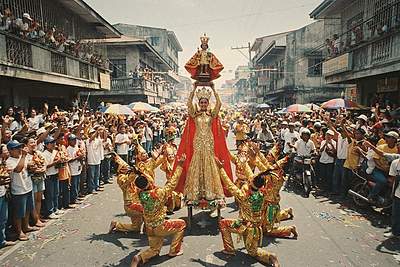 The troupe's festival queen, in her gold gown and red cape, lifts the Santo Niño high, with the dancers kneeling around her. Look at the balconies: people were watching from every floor. And where were my husband and son through all this? Joshua spent most of the afternoon on Rey's shoulders, shouting Pit Señor at every troupe, every drum, every passing Santo Niño, until he lost his voice completely. By Monday he could only whisper. His teacher sent a note home asking whether he was ill. I wrote back that he was not ill, only devoted. 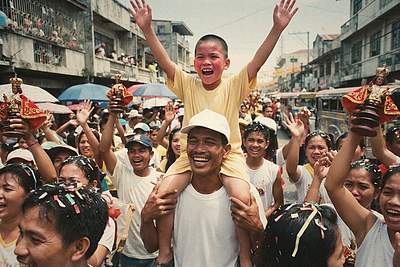 Rey and Joshua in the crowd. Joshua has both arms in the air and is shouting Pit Señor for perhaps the two-hundredth time; Rey is laughing and holding on to him. All around them, people are holding up their own small Santo Niños. The troupe did not win anything. I have read the results, and I have considered them carefully, the way I consider a composition, and I have concluded that I do not care at all. My daughter danced for the Santo Niño in front of her whole city, and came home on her own two feet, and that is the only prize I wanted. About those feet: blistered, both of them, blisters on top of blisters. She soaked them in a basin of cold water that night with her makeup still on and glitter in her eyebrows, and before she fell asleep in the chair she told me she wants to dance again next year. Mae's Own Words
(I did not already say yes. I said we would see. But we will see, and she knows what that means.) Thank You, Sir Ronald Daghang salamat, Sir Ronald. For three months you gave your afternoons and your Saturdays to a crowd of teenagers who were tired and hot and sometimes, I am told, impossible. You taught them the steps, but you also taught them to come on time, to drink their water, to fix each other's headdresses, and to keep dancing when they had nothing left. I am a teacher too, and I know how much of that work nobody sees. I saw it. So did they. And daghang salamat to the other mothers, who sewed through December as I did. When we finally saw the whole troupe together in the street, every sequin was worth it. Sinulog 2000 Next year the Sinulog falls on Sunday, January 16, 2000, the third Sunday of January. Mae has already told Sir Ronald she is coming back, and I have already bought more sequins, just in case. To my sister and to our cousins in the States and in Italy: if the world survives the new year, and the computers do not all stop at midnight the way the newspapers keep warning us, come home for it. We will have the umbrellas, the bottled water and the pan de sal waiting for you on the curb, and Joshua should have his voice back by then. Probably. Amping, all of you, and Viva Pit Señor!      visitors since February 1999. Thank you for coming.  Write to me: [email protected] Last updated Monday, September 20, 1999 |