GeoCities.us
» CapeCanaveral » Runway
|
GeoCities.us
» CapeCanaveral » Runway |
Get your FREE home page! |
 |

|
2 7 — — — — — — |
 |
WHAT YOU'RE LOOKING AT
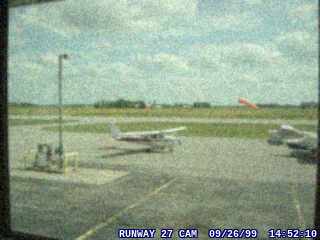
The camera sits on the windowsill in the lobby of Moffett Aviation, the FBO (fixed-base operator, which is the airport's gas station, flight school, rental counter and coffee pot all in one). Left to right:
- The fuel island. Self-serve avgas, the blue 100 low-lead that piston airplanes burn. The yellow posts are there so nobody taxis a wingtip into the pump. That happens more than you would think.
- The light pole. It comes on at dusk, right about when the camera shuts off.
- The ramp. The painted lines and chains are tie-downs. Planes that live outside get chained down by the wings and tail so the wind can't flip them.
- The taxiway and the runway. Runway 9-27, 4,000 feet of asphalt, with white edge lights on the little stalks. Planes taxi out on the taxiway, turn onto the runway at the end, and take off.
- The windsock. The orange cone on the pole. It points the way the wind is blowing to. Straight out means 15 knots or more. Hanging down means calm.
- Beyond the fence. Soybeans, a lot of them, turning yellow right now, and the Ashworth place with the red barn. Every pilot in the county uses that silo as a landmark.
This afternoon's picture: that's our Cessna 172 taxiing out with a renter and his wife going for a hamburger at another airport. (Pilots call that the hundred-dollar hamburger, and it's not much of a joke.) See the windsock pointing to the right? Wind out of the west. That means they'll be taking off on runway 27, toward the west, and that's why they're taxiing to the far end.
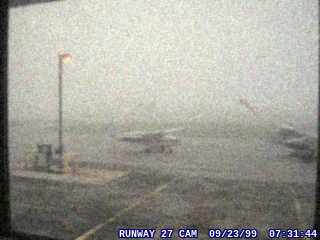
FOG MORNING
Thursday, September 23, 1999, 7:31 a.m.
I saved this one. The camera came on at 7 and this is what it saw: ground fog so thick you can't see the runway, the dew dripping off the 172 we left out on the ramp the night before, and the windsock hanging there with barely a breath of wind to move it. The light over the pumps hadn't shut off yet. My 7:30 lesson got pushed to the afternoon. By 10 the fog had burned off and it was the best flying day of the week. Students don't fly in fog. Neither do smart pilots.
WHAT FLIES IN
- Cessna 152s. We have two on the rental line. Two seats, high wing, the plane most people learn in, including me. Snug if you're over six feet.
- Cessna 172. One on the line. Four seats, a little more power, the one in today's picture.
- Piper Cherokee. Low wing, belongs to a dentist in town who flies it every nice Saturday. You can tell a Piper from a Cessna on the cam because the wing is under the cabin.
- The crop duster. Bright yellow, big engine, shows up in July and August to spray. Fuels up loud and leaves louder.
- Corporate twins. Now and then a King Air from one of the factories comes in. It burns jet fuel, which comes out of the truck, not the pump.
- Summer evenings. An old yellow Piper Cub from the hangars goes up most nice evenings just to go around the county. If you see a little yellow plane after supper, that's the one.
MY LOGBOOK SO FAR
I'm David, I'm 19, and I pump gas, wash airplanes and push them in and out of the hangar here. I take classes at the branch campus. Every spare dollar goes into flying lessons.
When What Saturday, March 6, 1999 Discovery flight with Jackie. I flew the whole thing except the landing. Hooked. March 1999 Third-class medical and student pilot certificate. May 1999 Mr. Moffett lets me put the camera in the lobby window. This page goes up. Saturday, June 12, 1999 FIRST SOLO! Three takeoffs and three full-stop landings in a 152, nobody in the right seat. Afterward Jackie cut the back off my shirt and wrote the date on it. It's hanging in the lobby, just out of the camera's view. Thursday, August 19, 1999 Passed the FAA written test with an 88. September 1999 31.4 hours total, 6.8 of them solo. Next Solo cross-country flights, including the long one, 150 nautical miles with landings at three airports. Night flying. Hood time. Then the checkride, hopefully by Christmas.
HOW TO START FLYING
- Take a discovery flight. Most flight schools do a short first lesson cheap. You'll know in twenty minutes whether you want to keep going.
- Get a medical. A third-class medical from an aviation medical examiner. The doctor gives you your student pilot certificate too.
- Find an instructor you like. A CFI, a certified flight instructor. Mine is Jackie Golson, who has never once raised her voice at me, even the day I tried to land fifteen feet above the runway.
- Study. Ground school or books, then the FAA written test.
- Fly a lot. The legal minimum is 40 hours, but most people take 60 or more. Flying twice a week helps you remember what you learned. Once every two weeks, you spend half of each lesson catching up.
- The checkride. An oral exam and a flight with an FAA examiner. Pass and you're a private pilot.
It isn't cheap. I put most of every paycheck into it, and Mr. Moffett lets me work off some of my rental time washing planes. If you're near here and thinking about it, stop by the lobby and say you saw the cam. I'll show you around.
WHY PILOTS SAY "TWO-SEVEN"
Runways are numbered by their magnetic compass heading with the last zero dropped. Runway 27 points 270 degrees, which is due west. The other end of the same strip of asphalt points 090 degrees, due east, so it's runway 9. Same runway, two numbers, depending on which way you're going.
Airplanes take off and land into the wind, because it gets you off the ground in less distance and slows you down for landing. Around here the wind blows out of the west most days, so most days it's runway 27. On the radio you say each digit, "two-seven," so nobody mixes it up with anything else. We have no control tower, so pilots tell each other what they're doing on the common frequency. You'll hear something like "McCarthy traffic, Cessna Four-Six-Kilo departing runway two-seven, McCarthy."
Thanks to Lewis Moffett for letting me put a camera in his window and run this page off the counter computer (it's a hand-me-down running Webcam32 and a QuickCam, and it works just fine), and to Jackie Golson for teaching me to fly. McCarthy Field is named for Nathaniel McCarthy, who farmed the land and gave it to the county for an airport after the war.
You are visitor
since Saturday, May 15, 1999
E-mail David: [email protected]
Last updated Sunday, September 26, 1999