 GeoCities.us
» CapitolHill » Rotunda
|
GeoCities.us
» CapitolHill » Rotunda |
Get your FREE home page! |
 |

|
|
 July 16, 1999: The Day I Became a Citizen by Danielle Kumar, Edison, New Jersey I was born in Hyderabad, India, and came to the United States in 1986, when I was eleven, with my parents and my older brother Philip. My father had a job offer from a pharmaceutical company in New Jersey, and we have been in Edison ever since. I went to middle school and high school here, went to college here, and now I'm a sales trainee at a medical-supply company. I have lived more of my life in New Jersey than anywhere else. And on Friday, July 16, 1999, in a courtroom in Newark, I became an American citizen. I made this page for my cousins in Hyderabad and my friends who couldn't be there, and also because when I started the process I wanted to know what it would really be like, and I couldn't find anybody who had written it down. 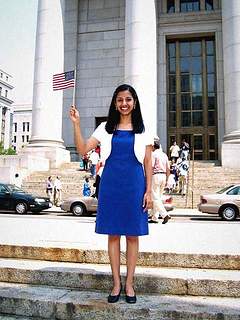 Right after the ceremony, on the steps across the street from the courthouse. That flag is the little one they give everybody. How It Works
My timeline: application mailed in April 1998, fingerprints in August 1998, interview in May 1999, oath on July 16, 1999. About fifteen months. Some people wait longer. Be patient and keep your copies. Studying: I made index cards for the civics questions and kept them in my purse. I knew most of the answers from school, but there were a few that stumped me, like how many amendments the Constitution has (27) and how long a senator's term is (six years). At the interview the officer asked me six questions and I got all six. Then she said, "Congratulations," and I had to sit still for a second. The Day It was hot, the kind of July day in New Jersey where the air feels like a wet towel. I wore my blue dress. We drove up to Newark early, all of us, Mom and Dad and Philip and my grandmother, who we call Ammamma (that's what you call your mother's mother in Telugu, our language at home). The ceremony was in a courtroom in the federal courthouse, with about 150 of us being sworn in and our families packed in behind us. The clerk read out the names of all the countries people were from, and when she called yours, you stood up. India had a good-sized group. So did Poland, the Philippines, Colombia, Portugal and the Dominican Republic, and there were people from countries I had to look up afterward. The judge talked to us about what it means. Then we all raised our right hands and took the oath together, all 150 voices at once, in all our different accents. Then it was over, and everybody was clapping, and a lot of people were crying, and I was one of them. Handing in my green card was strange. I had carried it in my wallet for six years. I felt sad about it for about one second. 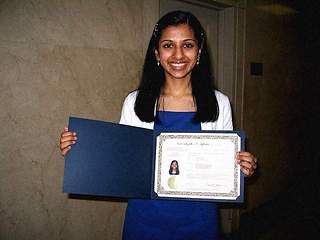 In the hallway outside the courtroom with my certificate. Philip wouldn't let me put it away until he got this picture. What It Meant to My Parents 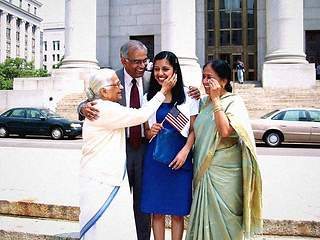 Outside, with Dad, Mom and Ammamma. Mom had been crying since the clerk read "India." My parents left everything they knew in 1986, their parents, their brothers and sisters, their friends, and brought two kids to a place where it snowed. My mother cried every night the first winter, she told me later, and never once in front of us. They did it so Philip and I would have more choices than they had. So when I came outside, my mother held onto me and couldn't talk, and my father, who doesn't say much, shook my hand like a businessman, and then hugged me and didn't let go for a long time. Ammamma, who came to live with us two years ago and speaks almost no English, put her hand on my cheek and said something in Telugu that I'm going to keep for myself. Philip took his oath in April. Mom and Dad sent in their own applications this spring and are waiting for their interviews now. Mom is nervous about the test. So now we sit at the kitchen table after dinner with my index cards, and I ask her who the first President was and what the stripes on the flag stand for, and she gets them all right and still worries. She's going to be fine. The Party 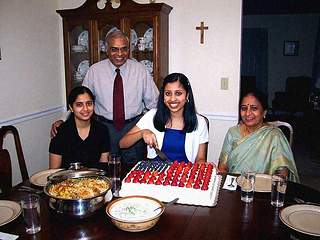 Dinner at home, with Mom's biryani and Mom's flag cake. Left to right: Sophia, Dad, me and Mom. That night Mom made chicken biryani, which is the Hyderabad specialty and the best thing she cooks, with raita on the side, and for dessert a sheet cake she decorated like a flag, with rows of strawberries for the stripes and blueberries for the stars. Philip's wife Sophia came, and our neighbors stopped over for cake. Ammamma had already gone to bed by the time Philip got his camera out, which is why she isn't in this one. It had been a long day for her. She had a piece of cake for breakfast. All the pictures on this page are from Philip's digital camera, the kind that saves the pictures right onto a floppy disk. He bought it for work and uses it for everything. What's Next
If you're going through the process and have questions about what it was like, write to me. I can't give legal advice, but I can tell you it's worth it. Visitors since July 1999:     [email protected] Last updated August 22, 1999 |
|