|
¡Bienvenidos, familia! We are Robert and Josephine Ramirez, Stephanie's grandparents, and we made
this page for all of you in California and in Mexico who could not be with us on June 12, when our
granddaughter Stephanie, the daughter of our son Alfredo and his wife Rosa, celebrated her quinceañera.
We missed you so much. Tu abuelita cried three times that day, and I will tell you
when.
These are our own snapshots. The photographer's proofs are not back yet (he says three more weeks), so you
will have to forgive Robert's thumb in a few of them. Some of you cousins didn't grow up with these traditions,
so I am going to explain each one as we go, the way my mother explained them to me.

La Misa · The Mass
A quinceañera begins in church, because before it is a party, it is a thanksgiving. At eleven in the
morning, Stephanie walked down the aisle of our parish church with her court, and Father thanked God with all
of us for her fifteen years. She renewed the promises her padrinos made for her at her baptism, received her
medal and her Bible and rosary, and at the end she took her bouquet of pink roses to the altar of Our Lady of
Guadalupe and left it there for the Virgin. That is the part where your abuelita cried the first time.
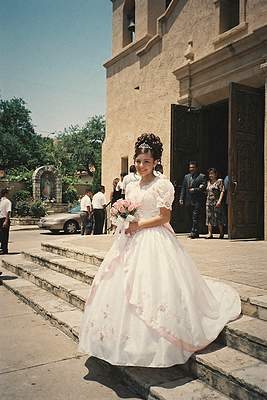
Stephanie on the church steps after Mass. Isn't she a beauty? She looks like her mother. (Robert says she looks like him.)
Her dress is white satin with pink trim and little pink roses embroidered on the skirt, and the lace on top was
sewn on by hand. Her tiara has rhinestones that catch the light. She chose every bit of it herself, and she
tried it on at the shop four times before she was sure.
La Corte de Honor · The Court of Honor
A quinceañera has a court, like a little wedding party, of her closest friends and cousins. Stephanie's
court was seven damas, the girls in the pink gowns, and seven chambelanes, the boys in the tuxedos
and pink vests, plus her escort, the chambélan de honor, Joshua, who is sixteen and very polite and
whose mother I have known since second grade. The court practiced their waltz every Sunday afternoon since March
in the parish hall, and by June they were very good, and very tired of the music.
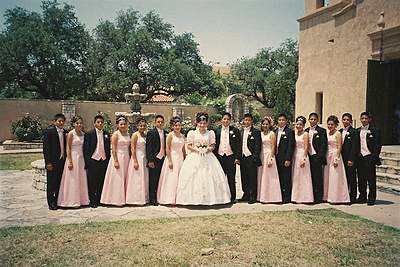
The court in the church garden, with Stephanie in the middle. The boy at the far right is her little brother Alejandro, who is thirteen and was not in the court, but he was not going to be left out of the picture.
La Recepción · The Party
That evening we had dinner and a dance for about three hundred people in the parish hall. Yes, three hundred.
You know this family. I manage a school cafeteria, so I said, I can feed three hundred people, I do it every day,
and my ladies from the cafeteria came and helped, God bless them: rice, beans, enchiladas, and Robert's sister's
pan dulce for later. The hall was all pink and white, with streamers and balloons and colored lights over the
dance floor.
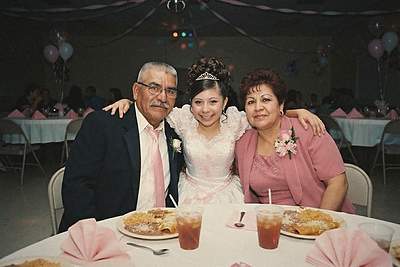
Los abuelos with the quinceañera. Robert loosened his tie as soon as the Mass was over. I made him tighten it for this picture, and he loosened it again after.
El Cambio de Zapatos · The Changing of the Shoes
This is one of my favorite traditions. Stephanie came into the party wearing flat shoes, like a girl. Then she
sat in a chair in the middle of the dance floor, and her father knelt down in front of everyone and took off her
flats and put on her first pair of high heels, to show that she is a young woman now. Alfredo practiced at home
with Rosa's shoes so he wouldn't fumble it, and he still laughed the whole time. So did she.
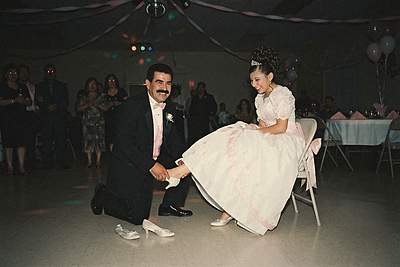
Alfredo changing his daughter's shoes. The flats are on the floor by his knee.
La Última Muñeca · The Last Doll
Stephanie's madrina Kristy gave her a porcelain doll dressed in a little white and pink gown just like hers. It
is called the last doll, because it is the last doll of her childhood. After she danced with it for a moment, she
gave it to her little cousin, who is six and has not let go of it since.
El Vals · The Waltz
Then the lights went down, and Stephanie danced her first waltz as a young woman with her father. Everyone stood
up to watch. That was the second time your abuelita cried, and Robert too, but he says it was the smoke from the
candles. Then Robert danced the next part with her, and only stepped on her once. Then the whole court danced the
waltz they had practiced all spring, and they did it beautifully.
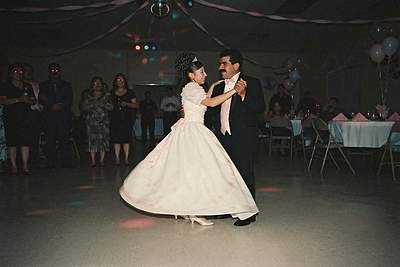
The father-daughter waltz.
El Pastel · The Cake
And the cake! Four tiers, pink roses, little sugar pearls, and a real fountain in the middle that lit up, with two
little cakes on the sides and tiny staircases going up to the big one. The children stood in front of it all night
watching the water go around. Robert said it was too pretty to cut. Then he had two pieces.
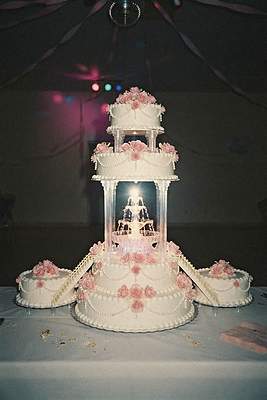
The cake, a gift from Tía Benita and Tío Joe.
We danced until midnight. Robert and I danced to our song, the one from our wedding in 1960, and the young
people were very kind and clapped for us. At the end of the night Stephanie came and hugged us both and said it
was the best day of her life. That was the third time.
Los Padrinos · With Thanks
At a quinceañera, the godparents and family friends who sponsor each part of the day are called padrinos.
We could not have done it without them. From the bottom of our hearts, muchas gracias:
- Tía Benita and Tío Joe, for the cake
- Carmen, for the dress
- Nadine and Roy, for the tiara
- Kristy, for the last doll
- Gail, for the Bible and rosary
- and our cafeteria ladies, the court's mothers, Father, and everyone who set up tables and folded napkins
until two in the morning on Friday night
The fourth time I cried was writing this page. Que Dios los bendiga a todos. When the photographer's proofs
come, I will put up the best ones, and we will send copies to all of you.
Con mucho cariño,
Josephine (and Robert)
Familia who have visited:
   
Write to us! [email protected]
Last updated Sunday, August 22, 1999
|
 GeoCities.us
» Heartland » Valley

