GeoCities.us
» Hollywood » Bungalow
|
GeoCities.us
» Hollywood » Bungalow |
Get your FREE home page! |
 |

Franklin's Radio Room Sixty-three tube radios, every one of them playing |
|
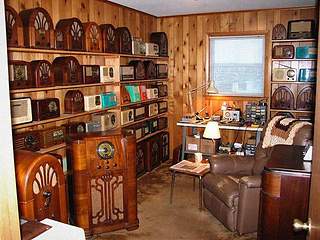
Come in, and mind the cords. My name is Franklin Costner. I ran a radio and television repair shop here in Springfield, Missouri, from 1949 until I retired in 1991, and for most of those years I fixed other people's radios all day and came home and fixed my own at night. I learned radio in the Navy, as a radioman from 1942 to 1945, and I have never gotten over it. When I retired I started buying the old sets that came through estate sales, auctions and flea markets, and a good many came from folks who remembered my shop and figured I'd give Grandpa's radio a good home. There are sixty-three of them now, and every one plays. They live in our back bedroom, which my wife Florence named the Radio Room. She does not care to go much past the doorway, so that's where she stood to take these pictures for me. I learned how to make a Web page this spring, in a class at the senior center, and the center lent me their camera, the kind that saves the pictures on a floppy disk. So bear with an old man. 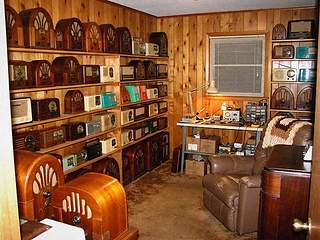 The Radio Room, from the doorway The shelves are pine, and I built them myself in 1992 when the radios ran out of other places to be. The wooden ones with the rounded tops are cathedral and tombstone sets from the early 1930s. The square brown and ivory ones are Bakelite and plastic table sets from the late '30s through the '50s. The workbench is under the window, and the recliner is mine. |
|
Four Old Friends The Philco Cathedral The Zenith Console The Brown Bakelite Table Set The Silvertone |
|
What They Pull In at Night |
|
A Beginner's Primer on Restoring an Old Set 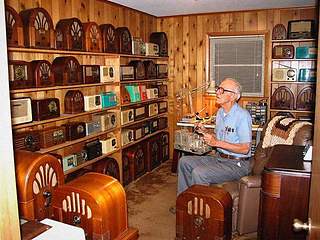 Me at the bench with the iron hot 1. Don't plug it in. I know you want to. Don't. A radio that's sat for forty years has capacitors in it that have dried out or gone leaky, and if one of them shorts the minute you turn it on, it can burn out the power transformer, which is hard to replace, or start a fire. Have somebody who knows old sets look it over first, or learn to do it yourself. 2. Replace the capacitors. The old paper capacitors, the little black or brown tubes covered in wax, go bad with age, every one of them, sooner or later. So do the electrolytic filter capacitors, the big ones. Replace them all with new ones before you bring the set up. In the picture below you can see the new yellow ones I've put in and the pile of old black ones I took out. 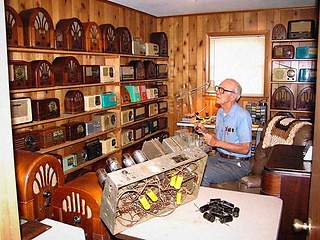 The chassis on the card table. New capacitors are the yellow ones. That's me in the back, waiting for Florence to finish taking the picture. 3. Bring it up slowly. When it's ready, bring the voltage up a little at a time with a variable transformer, or put a light bulb in series with it, so that if something's still wrong you see it glow instead of seeing smoke. 4. Test the tubes; don't throw them out. Tubes last a long, long time. Check them on a tube tester and replace only the bad ones. A good many radio shops and old-timers still have a tester. 5. Look for trouble. Burned resistors, rubber-covered wire that's gone hard and cracked, a frayed line cord. Replace the line cord on every set, no exceptions. 6. Respect the electricity. The filter capacitors can hold a charge after the set is unplugged, enough to knock you down. And a lot of the small table radios from the '30s through the '50s have no power transformer, and the metal chassis is connected right to the power line. Never touch the chassis of one of those with it plugged in, and don't work on one without an isolation transformer. 7. Find the schematic. For most sets made after the war, the Sams Photofact folders have the diagram and the parts list. For older ones, the Rider manuals. The library may have them, or a radio club member will. 8. Go easy on the cabinet. Clean it gently and wax it. Don't strip a finish that just needs cleaning. And keep notes. You won't remember in ten years what you did, and the next fellow will want to know. |
|
What Came Out of These Radios  Visitors to the Radio Room since June 1999:    
If you've got an old radio and a question, write to me. Last updated Thursday, September 9, 1999 |
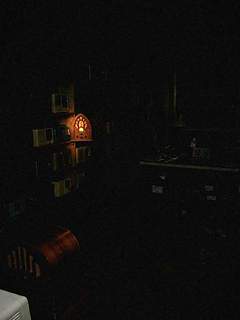 I believe this is a 1931 Philco Model 90, the shape everybody thinks of when they think of an old radio,
with the pointed arch and the carved grille. I found it at an estate sale in 1993, sitting in a garage under a
sack of potting soil, for forty dollars. It needed new filter capacitors, every paper capacitor in it, one
tube, and a new grille cloth, which I matched as close as I could. I took this picture myself at night with the
lights out, because that's when it's prettiest, with the dial lit up. The camera doesn't care for the dark, as
you can see. But you get the idea. Pull up a chair.