Eight Days in Honduras
Our Medical Team, March 13-20, 1999
by Fannie Olaughlin, RN · Knoxville, Tennessee
At the end of October 1998, Hurricane Mitch came ashore in Central America and then just sat there,
for days, raining. Honduras took the worst of it. Rivers came out of their banks, whole hillsides
slid down onto the towns below, and thousands of people were killed in Honduras alone. Roads and
bridges all over the country were washed away.
I'm a registered nurse in a family practice here in Knoxville. When our church decided to send a
medical team, I put my name down the first Sunday. Four and a half months after the storm, fifteen of
us flew to Tegucigalpa and drove south into the mountains to a town that had been cut off for weeks
after Mitch. For five days we ran a clinic out of the town's schoolhouse. We saw 1,140 patients.
This page is for the people at church who prayed for us and gave, for the families of the team, and
for anybody who's thinking about going on a trip like this. You should. Read the part at the bottom
first.
Click a picture to see it bigger.
The team
| Doctors |
Dr. Rex Blankenship, family medicine; Dr. Pamela Moore, pediatrics |
| Nurses |
Sylvia Krick (emergency room), Linda Dennison, Marylou Leach (retired school nurse), and me |
| Pharmacist |
Tom Dostal |
| Interpreters |
Jessica Lugo, who teaches high school Spanish, and Raymond Cabrera, who grew up speaking Spanish in South Texas |
| Everything else |
Sheldon McFadden (our deacon, who organized the whole trip), Dolores Rieger, Jean Lamere, Olivia Grizzard, Michael Shepherd and James Dahlberg: sign-in, the line, the children's corner, the generator, and the cooking |
What we carried
Thirty donated suitcases, two for each of us, every one packed right up to the airline's weight limit
with medicines and supplies: pain and fever medicine for adults and children, antibiotics, worm
medicine, blood pressure pills, vitamins, skin creams, bandages, a few hundred pairs of reading
glasses, toothbrushes. Our own clothes went in our carry-ons. We left the suitcases behind for the
town, empty. Somebody will be using them for twenty years.
The week
Saturday, March 13
Knoxville to Miami to Tegucigalpa. Everybody warns you about the landing in Tegucigalpa, where the
airport sits down in a bowl of mountains and the plane has to come in low over them and turn hard
and land short. Everybody is right. Marylou held my hand. We spent the night at a mission guesthouse in
the city. Along the river through the capital you could still see where the flood had come through.
 Sunday, March 14
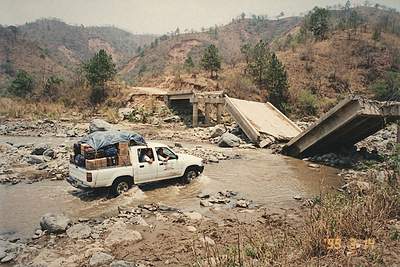
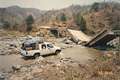
The drive south, in a rented minibus with a rented pickup behind carrying the bags. On a map it isn't
far. It took us all day, because the bridges are gone. Over and over the road would come down to a
river and there would be the bridge, broken in pieces in the riverbed, and the road would just turn
off down the bank and go across. It's the dry season now, so the rivers are low. In the picture the
pickup is crossing beside one of them; our minibus had just made it over and I got out to watch. Every
riverbed was a mess of boulders and dried mud, and on the hillsides you could see the long raw scars
where the land had slid. We got to the town at dusk and the church there had supper waiting.
 Monday, March 15 – first clinic day
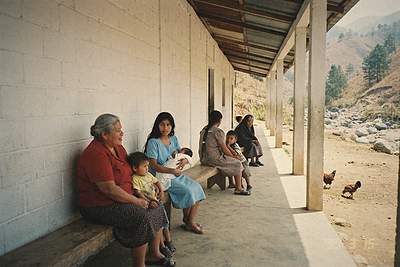
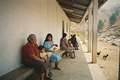
When we walked over to the schoolhouse at seven, the line was already the length of the porch: women
on the bench with babies on their laps, children sitting at their feet, old men leaning on the posts.
Some of them had walked three and four hours down out of the hills. Our helpers took names and ages
and what was wrong, with Jessica and Raymond going up and down the line. Then the nurses took blood
pressures, temperatures and weights; then the doctors; then the pharmacy. We set up in three
classrooms and the kitchen. 196 patients. The picture is the porch late that afternoon, when the line had finally
gotten short: a grandmother with her grandson, a young mother with her new baby, and behind them a
mother with her little boy and an old lady in a shawl. All of them said yes.
 Tuesday, March 16
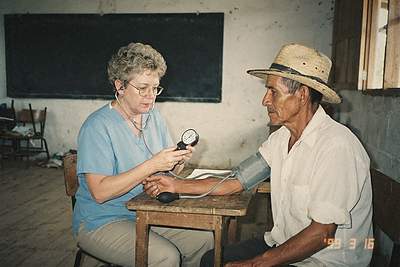
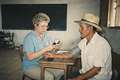
241 patients, our biggest day yet. This gentleman in the straw hat walked in from his farm with his
grandson. His blood pressure was high, and he had never had it taken in his life. Dr. Blankenship
started him on a pill and we sent him home with three months of it, which is what we could carry, and
the name of the health center that's supposed to reopen in the next town over. Sylvia took this
picture. I asked him first, through Raymond, and he said yes, and asked if he could see it when it was
printed. I've mailed him a copy, care of the church there.
 Wednesday, March 17
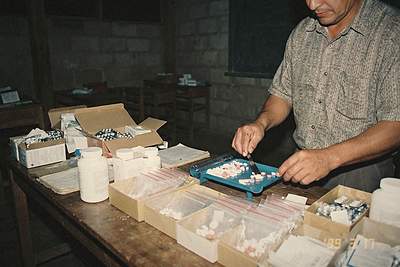
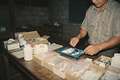
230 patients. This is Tom's pharmacy, on a long table in the last classroom: the big stock bottles,
the counting tray, and rows of little plastic bags, each with one person's pills counted out and the
directions written on in Spanish, with a sun and a moon drawn on for the ones who can't read, so they
know morning or night. Raymond spent his lunch hour counting with him. That night, at about half past
seven, the generator quit, with a room full of people still waiting. We finished the day by flashlight,
with James and Michael under the generator in the dark, and it was going again by breakfast.
Thursday, March 18
248 patients, the busiest day of the week, because word had gotten around. Dr. Moore saw children
all day without stopping for lunch, and the children's corner, with Olivia and Jean and a box of
crayons and a parachute game, never had fewer than twenty kids in it.
Friday, March 19
225 patients, and the last of the medicine. In the evening the church had a service for us, and they
sang, and we sang, badly, in Spanish, and nobody minded.
Saturday, March 20
Back over the rivers to Tegucigalpa and home. We were in Knoxville by midnight. I slept fourteen
hours.
| Patients seen |
| Monday | 196 |
| Tuesday | 241 |
| Wednesday | 230 |
| Thursday | 248 |
| Friday | 225 |
| Total | 1,140 |
What we saw
Mostly the everyday things that are no big deal here and a very big deal there: coughs and colds and
sore throats, children with worms and diarrhea from the water, skin infections and rashes, high blood
pressure that nobody had ever checked, bad backs and aching joints from a lifetime of farm work.
Every child over two got a dose of worm medicine whatever else they came in for.
And over and over, the families who had lost everything to the mud. A woman told me her house was
just gone, the whole hillside under it moved one night, and they had walked out with what they had on.
A man had lost his corn, his beans and his two cows. They weren't complaining. They were telling us so
we would understand why the baby's cough had gone on so long. I don't know what to do with that yet,
except go back.
Why I asked before every picture
These are people, not scenery, and they came to us sick and worried. So I asked every time, through
an interpreter, and if anybody hesitated I put the camera away. A few said no. Most said yes and then
wanted to see the camera. Nobody in the pictures is named here, and there are no pictures of anybody
being examined except the one gentleman who said yes twice.
If you're thinking of going
- See your doctor or the health department well ahead, six to eight weeks if you can, about the
shots you'll need and about malaria pills. Ours were taken once a week, starting before we left and
going on for four weeks after we got home, and you have to keep taking them after you're back.
- Get your passport early. Ours took six weeks.
- Drink only bottled or treated water, and brush your teeth with it. Peel it or cook it or leave it.
- Pack your own things light and the team's things heavy.
- Bring a flashlight. Bring two. Ask me why.
- Learn a little Spanish. "Buenos días," "gracias," "¿le duele?" (does it hurt?) go a long way.
- Go to serve, not to fix. They know their lives better than we do.
March 2000
The team goes back next March, to the same town. Eleven of us are already signed up. If you'd like to
be the twelfth, or to fill a suitcase, write me.
You are visitor
   
Write to me at [email protected]
Last updated Tuesday, August 31, 1999
|
 GeoCities.us
» HotSprings » Spa