GeoCities.us
» NapaValley » Cellar
|
GeoCities.us
» NapaValley » Cellar |
Get your FREE home page! |
 |

|
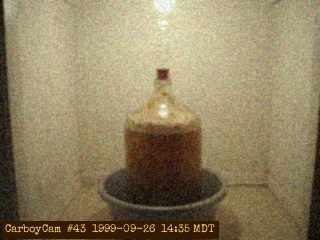
OBSERVATION, Sunday 9/26/99, 2:35 p.m. MDT. Batch 43, an Irish red ale, brewed yesterday afternoon. About 22 hours since I pitched the yeast and it is at high krausen: a thick, rocky tan foam sitting on top of the beer, already up into the shoulder of the carboy and headed for the neck. The brown streaks on the glass above it are hop resin and yeast that rode up on the foam and stuck. The airlock is going about once a second. You can't hear it on the cam, but in the hall it sounds like somebody slowly drinking through a straw. Note the gray washtub. See Entry 5. ENTRY 1. WHAT THIS IS I'm Dennis Link. I'm 35 and I work for the City of Fort Collins as a water-quality technician, which means I spend my days in the lab at the water treatment plant running samples (chlorine, turbidity, pH, the bacteria plates) and writing every number down in a notebook. I spend my weekends making beer and writing every number down in a different notebook. My wife Jennifer says this is not a coincidence. I've brewed at home since the spring of 1993, when Harry Case, a chemist at the lab, talked me through my first batch on our kitchen stove and then stood over me making sure I sanitized everything twice. For the record: making beer at home for your own use has been legal under federal law since February 1, 1979. I have never sold a bottle and I never will. I give a lot of it away, which is how I stay popular at the lab. The camera went up in June 1999. Blame two things. One is the famous coffee pot camera at the computer lab at Cambridge University in England, which has been on the Web since 1993 and is, as far as I can tell, how the whole idea of pointing a camera at something boring and putting it on the Internet got started. The other is Thomas Raley's Tidepool PotCam out in Sunnyvale, California, a coffee pot at a software company that updates every five minutes, the same as this one. I figured if a coffee pot could have a following, five gallons of live yeast had a shot. ENTRY 2. HOW TO READ THE CAM Every batch goes through the same four stages. Here's what each one looks like from the closet shelf.
ENTRY 3. BATCH 43: IRISH RED ALE An Irish red is a malty, easy-drinking ale, copper to deep red, not much hop bite, a little roasty dryness at the end. The red comes from a few ounces of roasted barley. I made one back in 1995 (Batch 15, see the log) and this is the same idea with four years of practice behind it. Extract brewing, with specialty grains steeped for color and flavor. Five gallons.
BREW DAY LOG, Saturday 9/25/99
GRAVITY. Original 1.046. Target final about 1.012, which works out to about 4.5%
alcohol. Fermenting at 66 F, which is where the closet sits all year. ENTRY 4. BATCH LOG, 1993 TO NOW Every batch I've made, with the grade I gave it after the first bottle. I grade hard. A C is something I'd drink but wouldn't hand you. Kits until Batch 4, steeped grains ever since.
Running tally: 41 graded. One F, one A, and a lot of B's, which is about right. Christmas ale every November since the first one, by request. ENTRY 5. THE NIGHT BATCH 39 BLEW
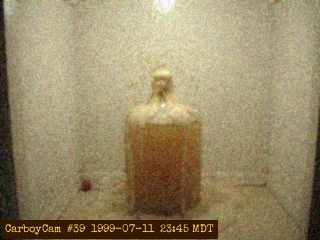
Batch 39 was an American pale ale with Cascade hops, brewed Saturday, July 10. I did what I'd done a dozen times before: a full five gallons in the five-gallon carboy, filled right up into the shoulder, and nothing on top but an airlock. It was July, the closet was running warm, and the yeast was healthy. Too healthy. At 11:45 on Sunday night Jennifer was up reading and heard a pop from the hall like somebody opened a bottle of champagne. The foam had filled the neck, plugged the airlock, built up pressure and shot the stopper and the airlock clear across the closet. By the time she opened the door it was pouring out of the open neck and down the sides, and there was a puddle spreading across the floor toward the hall carpet. She came and got me. I'm told I said "is the camera getting this" before I said anything else. I'm not proud of that. It was, though, and that's the frame. We cleaned up with every towel in the house, I sanitized a new stopper and airlock and put it back on, and the beer turned out fine, a solid B. The closet smelled like a brewery for two weeks. Since then:
ENTRY 6. WANT TO TRY IT? Here's what you need for five-gallon extract batches. The homebrew shop here in town sells a starter kit with most of it for about $70. Add a carboy later.
And a notebook. Write everything down. When a batch comes out great you'll want to know why, and when one comes out like Batch 10 you'll really want to know why. ENTRY 7. THE SETUP The hall closet stays between 64 and 68 degrees all year, the steadiest spot in the house, so the coats moved out and the beer moved in. The camera is a little USB webcam on a shelf screwed to the side wall, about three feet from the carboy. Its cable runs under the door to my old Pentium 133 in the den, which got Windows 98 this spring so it would talk to the camera. A shareware webcam program grabs a frame every five minutes, stamps the batch number and the time on it, and sends it up here over a second phone line that just stays connected. The bulb is a plain 25-watt on a lamp timer, on at 6 a.m. and off at midnight. Light isn't good for beer, so it's the dimmest bulb the camera can still see by.      Questions, recipes, or you just want to say the foam looks good: [email protected] Last updated: September 26, 1999 |
 THE CARBOYCAM