
A Week in the Field at Galax
The Old Fiddlers' Convention, August 9-14, 1999
Linda Sprouse · clawhammer banjo · Mount Airy, North Carolina
I drive a school bus in Mount Airy, and I have played clawhammer banjo since 1985. Every August since
1987, my husband Donny and I have loaded the camper, the tarps, the coffeepot and the banjo and driven
up the mountain to Galax, Virginia, to camp for a week in the field at Felts Park for the Old Fiddlers'
Convention. This was my thirteenth. Alvin Pasquale, who has fiddled with me for twelve years, parks his
camper next to ours, and between us and a couple of blue tarps we make a little village.
The convention has been held every year since 1935, put on by the Moose Lodge in Galax, in the week
leading up to the second Saturday of August. There are contests on the stage every night, and people
come from all over the country and the world for them. But if you ask anybody who's been coming as
long as I have, the real convention is out in the field, where thousands of people play music under
tarps until the sun comes up.
Here's our week.
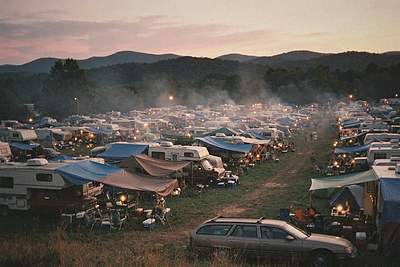
Sunday evening, August 8, from the rise at the edge of the field. And people kept coming all week.
Sunday, August 8
Set-up day. You'd think getting there the day before it starts would be early. It is not. Some folks had
been there a week already, and the field was mostly full. We wedged in at our usual end, Donny backed the
camper in on the second try, and Alvin's went alongside. Then the tarps: one big blue one strung between
the two campers on poles and ropes, and a brown one off the end for the kitchen. Chairs in a circle
under it. The first tune was going before the last rope was tied, the way it always is.
Monday through Friday
The contests start Monday night and run every night of the week on the stage in front of the grandstand,
a category at a time, until all hours. Fiddle, old-time and bluegrass; banjo, clawhammer and
bluegrass; guitar; mandolin; dobro; dulcimer; autoharp; folk song; flatfoot dancing; and the bands,
old-time and bluegrass. Contestants line up behind the stage with their instruments and go up one
at a time, and the announcer calls your name and your town and you walk up to the microphone and play
in front of a whole grandstand full of people who play better than you. That's my opinion, anyhow.
The days are slow. You sleep late, if the jam next door lets you. You eat. You walk the field and
listen. You go into town for ice. Somebody's always playing somewhere, and by about four in the
afternoon the whole field is one big sound.
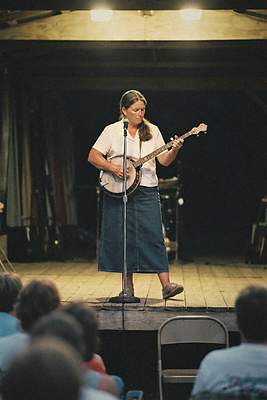
My turn. Donny took this from down front.
My turn in the clawhammer contest
I enter every year. I wear my white blouse and my good denim skirt, I tune for twenty minutes behind
the stage with a hundred other banjo players doing the same thing, and when my name is called I walk
out to the microphone with my knees knocking and play "Sally Ann" as clean as I can. This year I
didn't place. I never have, in thirteen years. The people who win can play rings around me and I go
and stand in the crowd and cheer for them. Then I go back to the field and play till daylight.
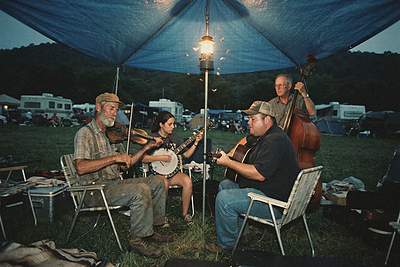
Thursday evening, the lantern just lit. Alvin's on the fiddle with his eyes shut. The young lady with the banjo drove up from Georgia.
The real convention
The best music at Galax doesn't happen on the stage. It happens in the field. Every camp has its jam,
and the good ones draw a crowd. Ours started Thursday about dark, the way it always does, with Alvin
and me and whoever wanders in, and it ran until the sky went gray behind the hills. A young lady from
Georgia sat in on banjo and played better than me. A man from Ohio with a guitar, a fellow with an
upright bass from somewhere around Asheville. We played "Sally Ann" for about fifteen minutes straight
at two in the morning and nobody wanted to stop.
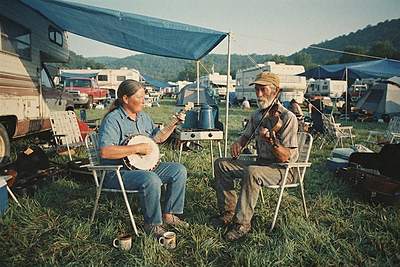
Friday morning. We hadn't been to bed. Coffee on the camp stove, and one more tune.
Saturday, August 14
The last night. By Saturday the field starts to thin out, the people with jobs drive home, and the rest
of us play it out to the end. Sunday morning we take down the tarps, roll them wet, and drive back
down the mountain. Donny says the same thing every year on the way home, which is how many days it is till next time.
This year it was three hundred and fifty-eight.
Old-time or bluegrass?
People who are new to this always ask. They're cousins, but they're not the same thing.
- Old-time is the older music, the dance music of these mountains. The fiddle leads, and
everybody plays the tune together, the whole way through, over and over. There are no solos. The banjo
is played clawhammer: you strike down on the strings with the back of a fingernail and catch
the fifth string with your thumb, and it makes a rhythm as much as a melody.
- Bluegrass came along in the 1940s. Everybody takes a turn playing a solo, a "break," while
the others back them up. The banjo is played with three fingers and picks, fast and bright, rolling.
At Galax the two live side by side and borrow from each other, and the field is full of both. If you
hear a banjo going fast and fancy, that's bluegrass. If you hear a banjo going bum-ditty bum-ditty under
a fiddle, and twelve people playing the same tune for twenty minutes, that's us.
A dozen tunes we played
| Sally Ann | The first tune Alvin and I ever played together, and my contest tune. In A. |
| Cluck Old Hen | Alvin tunes his fiddle AEAE for it and the whole henhouse comes out. |
| Breaking Up Christmas | A Round Peak tune from right up the road from Mount Airy. We play it in August and nobody minds. |
| Soldier's Joy | The one strangers can always play together inside a minute. |
| Shady Grove | Lonesome and minor. Everybody knows a different set of verses. |
| Sail Away Ladies | Alvin's favorite. You can't play it without smiling. |
| Cripple Creek | The first tune every banjo player learns, and one we never stop playing. |
| Forked Deer | A D tune with a high part that keeps the fiddler honest. |
| Cumberland Gap | Named for the gap the old Wilderness Road went through. Drives like a wagon going downhill. |
| Sugar Hill | Short and bouncy. When we play it, the flatfooters come out of the dark. |
| Bonaparte's Retreat | Slow and grand. Alvin tunes his low string down to D for it, and it sounds like bagpipes. |
| Fortune | Sweet and a little sad at the same time. Our last tune most nights. |
For the banjo players: for tunes in A, I tune up a whole step from open G (gDGBD becomes
aEAC#E). For tunes in D, I go to double D. Yes, it means a lot of tuning. Yes, everybody waits.
If you've never been
- Bring a tarp. Bring two. It rains most years, hard, in the afternoon.
- Bring a lantern and a flashlight. The field is dark and full of tent ropes.
- Bring a folding chair. Nobody has an extra.
- Bring earplugs if you'd like to sleep. Somebody will be playing outside your camper at 4 a.m.,
and it might be me.
- Ask before you sit in on a jam. Most will be glad to have you. Listen a tune or two first, play
along quietly, and don't start a tune in somebody else's jam until they ask you to.
- Walk the whole field at least once, at night. You'll hear things you never forget.
If you play the fiddle, or want to, I send everybody to Fiddle Tunes by
Ear, Old Joe Halvorsen's page about learning tunes the old way, by listening, with the tunes and
keys he'd start a beginner on. That's how Alvin learned and that's how I learned the banjo. No paper.
Pickers and listeners since last August:
   
Write me: [email protected]
Last updated Saturday, August 21, 1999
|
 GeoCities.us
» Nashville » Ryman

