GeoCities.us GeoCities.us » Orchard » Grove Get your FREE home page!

Soriano Durian Farm
Calinan, Davao City, Mindanao, Philippines
The 1999 Harvest

"Smells like hell, tastes like heaven."
-- as everyone in Davao says about the durian

The Season So Far | A Short Lesson | Choosing & Opening | Sunday on the Porch | Other Fruits | Seedlings | Our Story | Kadayawan | Visit Us

Maayong buntag! Good morning, and welcome to our farm.

My name is Roberto Soriano. For 28 years I taught agriculture at a public high school here in Davao. In 1997 I took early retirement, and now I farm full time with my wife Aida on our three hectares in Calinan, a farming district of Davao City, in Mindanao. After 28 years of telling teenagers how to grow things, I am finally doing it myself from morning to night. I have found that the trees listen better than the students did, although they are slower to answer.

We grow durian, about 150 grafted trees among older coconuts, with pomelo, mangosteen, rambutan and lanzones besides. This page is about the 1999 durian season, which is going well, thanks be to God.

Our son Raymond, who is a programmer in Manila, made this page for us when he was home in August. I write it by hand on Sunday afternoons and send it to him in Manila with the photographs, and he types it in. So if this page is long, blame the teacher, not the typist.

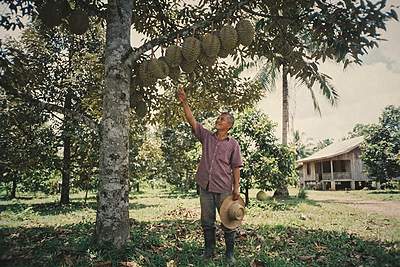
Roberto, in a checked short-sleeved shirt and rubber boots with a straw hat in one hand, stands under a big durian tree and points up at a cluster of large spiky green fruits hanging from a low branch; a farmhouse with a wide porch and a coconut palm stand behind
Sunday, August 15. Your teacher under one of our trees, showing you where the fruit hangs: from the thick branches, on short stems, close to the wood. Count them on that one branch. I make it about a dozen. Behind me is our house with the porch, and one of my father's coconut palms. Aida took this picture and told me to stop pointing like I was in front of a class. I was not able to stop.

WHO IS WHO ON THIS PAGE
RobertoMe. 54. Retired agriculture teacher, full-time farmer, writer of this page.
AidaMy wife. 54. Keeper of the scale, the stand and the prices.
RaymondOur son. 28. Programmer in Manila. The typist.
GretchenOur daughter. 24. A nurse at a hospital in Davao City. Cannot stand the smell of durian. You will hear more about this.
Nong OscarOscar Cordero, 41. With us since 1990. Knows every tree.


The Season So Far


The first fruits fell in late July. Since then the season has come to its peak, as it does every year, in August and September, and as I write this in September we are right in the middle of it. I am glad to report that the harvest is good this year. The trees flowered well, the fruit set well, and so far the wind has been kind.

Not every year is a good one. A durian tree is like a student: it has good years and bad years, and a teacher learns not to take either one too personally.

OUR 1999 SEASON
Late JulyThe first fallers. Nong Oscar starts his dawn walks.
AugustThe peak begins. The stand is open every weekend. Raymond home. Kadayawan.
SeptemberStill at the peak, and the basket still full every morning.
After thatOnly the trees know.

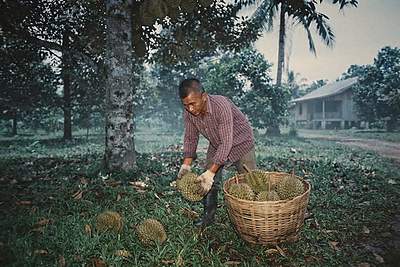
At dawn under the durian trees, Nong Oscar in a checked shirt and white work gloves bends to lay a spiky durian in a big woven basket that already holds four, with two more fallen durians in the wet grass Saturday, August 21, first light. Nong Oscar gathering the night's fallers. Four in the basket, a fifth in his hands, two more waiting in the grass. Every morning in season he walks the rows at first light, before the heat and before the stand opens. This time Raymond went along with the camera. He says it was the earliest he has been awake since college. Notice the thick gloves. That is a lesson too.
(Click on the small picture to see it bigger. -- R.)


A Short Lesson on the Durian


Old habits. Class, please take out a pen.

1The tree. The durian is a tall tree with a wide crown of dark green leaves. The fruit hangs from the thick branches, on short stems. (See the picture of your teacher above.)
2The fruit. Big, green-brown, and covered all over in hard thorns. It is heavy. Do not drop one on your foot.
3Inside. The fruit splits into five sections. In each one lie pods of creamy yellow flesh around big seeds.
4Ripeness. A ripe durian falls from the tree by itself, mostly at night or at dawn. That is why Nong Oscar walks the rows at first light to gather the fallers. On our farm, we let the tree decide when the fruit is ready.
5Safety. Nobody on our farm stands under a durian tree on a windy afternoon. (See the quiz below.)
6The smell. Strong. Very strong. It is the reason hotels and airplanes do not allow durian. Smells like hell, tastes like heaven.
7Eating. Fresh, with the fingers, is the best way. Durian is also made into candy and jam, which people bring home as pasalubong, because it travels better than the fruit.

QUIZ. Why does nobody on our farm stand under a durian tree on a windy afternoon? The answer is at the bottom of the page. No peeking. I will know.


How to Choose and Open a Durian


Choosing. You know a good durian by its smell and by the sound when you tap it. I wish I could teach you the sound over the Internet, but Raymond says I cannot. So come to the stand and let Aida choose for you. In all these years she has never chosen a bad one. I have, once or twice, and I have heard about it.

Opening. Here is how we do it at home.

  1. Spread old newspaper on the table. You will be glad later.
  2. WARNING: THE THORNS. They are hard and sharp. Never hold a durian in your bare hands to open it. Fold a thick towel over the fruit and hold it with that, or wear work gloves like Nong Oscar.
  3. Set the fruit down with the stem on the table, so the bottom faces up. Look for the seams, the faint lines where the five sections meet.
  4. Push the point of a big, strong knife into one seam and work it in a little. Then, with your hands in the towel, pull the two sides apart. It opens along the seam.
  5. Do the same with the other seams until the husk opens. Now you can see the yellow pods lying in their sections.
  6. Lift the pods out with your fingers and eat. Eat around the big seed. Do not try to eat the seed.
  7. Afterward, wash your hands well. Your fingers will remember the durian for some time.
Be careful with the knife. The husk is tough and the knife can slip, so keep your other hand out of the way. That is what the towel is for. Every season some balikbayan nephew tries to open one with his bare hands, to show us he has not forgotten how. He has forgotten.


Sunday on the Porch


On Sunday afternoon, after the stand closes, the family eats durian on the porch. It is the best hour of the week. You can see the lesson above in action: the newspaper, the big knife, the towel, and the open husk with the pods inside.

And now I must tell you about our daughter. Gretchen is a nurse at a hospital in Davao City. She has seen everything a nurse sees, and none of it bothers her. But she cannot stand the smell of durian. She grew up on this farm. As a girl she helped carry the seedlings when we planted these trees. We have discussed it as a family many times, and we have no explanation. It is the great scandal of the Soriano family.

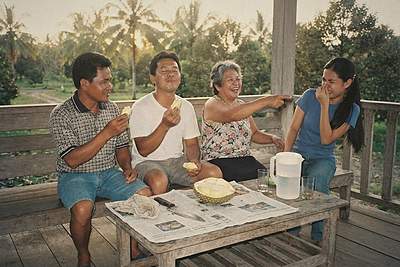
The family on a wooden porch in late-afternoon light around a low table spread with newspaper, an opened durian, a big knife, a towel and a plastic pitcher of water; from left, an older man in a checked polo shirt and a young man in a white T-shirt with his eyes closed each hold a yellow pod, an older woman points and laughs, and a young woman pinches her nose
Sunday, August 22, on the porch. From left: me, in my good checked shirt; Raymond, who has been in Manila too long and is making up for it with his eyes closed; Aida, laughing and pointing; and Gretchen, at the far end of the bench, holding her nose. Every Sunday she says she will sit with us, and every Sunday she sits at the far end of the bench. Nong Oscar took the picture before he went home. Lami kaayo! (Very delicious!) That is Raymond's opinion, and mine.

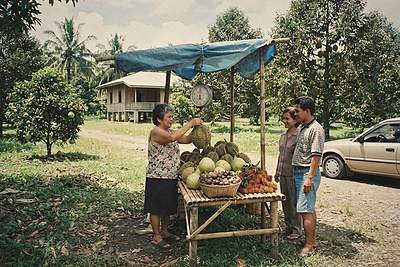
Aida at a bamboo fruit stand under a blue tarp by a country road, holding a durian up to a round hanging scale, with durians, pomelos, a basket of mangosteens and red rambutan on the table, a man and a woman waiting, and a parked car beyond Sunday, August 22, at the stand by the road, earlier the same day. Aida at the scale with a durian, and a couple who drove out from the city waiting to hear the weight. On the table: durians at the back, pomelos in front of them, a basket of mangosteens, and a pile of rambutan. Our house is behind, across the field. I took this one. The scale is older than Raymond and has never once been wrong. Aida asks me to add that neither has she.


The Other Fruits


The durian is the reason people come, but it is not the only tree on the farm. If someone in your car will not eat durian (and I know how that is), these are for them.

PomeloBig and pale green, with a thick rind. Inside are large sweet segments. It keeps well, so people take it home to the family.
MangosteenSmall, round and dark purple, with a thick rind. Press it between your palms until the rind cracks, and inside are soft white segments, sweet and a little sour. Mind your shirt: the purple stains.
RambutanRed and hairy, in bunches. Open the skin with your thumbnail and you find sweet white flesh around a seed. The children who come with their parents finish these first.
LanzonesSmall round fruits in bunches, with thin pale skin. Inside are clear, sweet segments. If a segment has a seed, do not bite it. It is bitter.
CoconutThe old trees, my father's, still standing among the durians. If you are thirsty after the stand, ask.


Grafted Seedlings


Every season farmers and gardeners ask me for durian seedlings, so we keep a small nursery near the house, under a shade roof of black netting on bamboo poles. Every seedling in it is grafted.

Why grafted? Here is the lesson. A durian planted from seed takes many years to bear, and when it finally does, its fruit may be nothing like its mother's. A grafted tree carries the fruit of the tree the graft was taken from, and it bears much sooner. Our own trees are grafted. Aida and I planted them between 1985 and 1988, and they began bearing in the early 1990s.

Grafting was the one lesson that every class liked. Even the boys in the back row woke up for it, because it looks like magic: you join two plants, and they grow into one tree.

If you take a seedling home: plant it where it has sun and plenty of room, because a durian grows into a big tree. Water it well while it is young. Keep the goats away from it. And be patient. How much? Ask Aida.

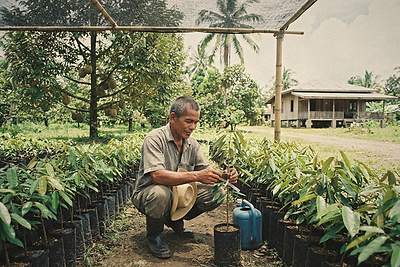
Roberto crouches among rows of young durian seedlings in black plastic bags under a shade roof of netting on bamboo poles, looking closely at one seedling, with his straw hat on his knee and a blue water can beside him Sunday, September 5, in the nursery. Checking a seedling, row by row, with my hat on my knee and the water can beside me. You can see the netting overhead and the house beyond. Gretchen took this picture. She likes the nursery very much. The seedlings do not smell.


Our Farm's Story


1950. My father and mother came to Davao from Bohol in 1950, when I was five years old, and they cleared this land with their own hands. They planted coconuts, and many of their trees still stand among our durians. I grew up on this land, I studied agriculture, and then I taught it for 28 years to the young people of Davao. On weekends and in the school vacations, I was still a farmer.

1985 to 1988. Aida and I planted the grafted durians, about 150 of them, among my father's coconuts, with the pomelo, mangosteen, rambutan and lanzones besides. Some people told us we were dreaming. The trees began bearing in the early 1990s, and those people stopped telling us that.

1990. Nong Oscar came to work with us. Here we call an older man Nong, out of respect. The children called him Nong Oscar from the first day, and soon everyone did, including me, though I am the older one. He has earned it. He knows every tree on this farm: which one bears early, which one sulks, which one drops its fruit near the path. I hope he stays with us many more years.

1997. I took early retirement from teaching and came home to the trees full time. Aida says she has had a husband underfoot ever since.

One more thing I tell every visitor. Davao lies south of the typhoon belt. A durian tree takes many years to grow, and one bad storm could undo them, so I count this among God's gifts, together with the rain, the good soil, and Aida.


Kadayawan


August in Davao is Kadayawan, our city's thanksgiving festival for the harvest. This year all of us went into the city for the parade, with its floats of fruit and flowers. Raymond was home for it. Gretchen came too, and she enjoyed the flowers very much.

As a fruit farmer, I can tell you it is a fine thing to see a whole city stop and give thanks for what grows. We gave our own thanks too, more quietly, that Sunday on the porch, with a durian.


Come and Visit


Our stand by the road is open on Saturdays and Sundays during the season, and Aida is at the scale. People drive out from the city, and balikbayans stop on their way to the airport for one last durian, since, as you learned in the lesson, they cannot take one on the plane. So eat it here. We have newspaper, a knife and a towel.

How much? Ask Aida. Raymond wanted to put the prices on this page, and Aida said the prices are in her head, and they are staying there.

How to find us: we are in Calinan. Ask anyone for the Soriano farm, or look for the blue tarp by the road.

And if you come on a clear morning, you can see Mount Apo from our porch. Come early. I will make the coffee.


ANSWER TO THE QUIZ. Because a ripe durian is heavy and covered in hard thorns, and on a windy afternoon it may decide that today is the day to fall. Gretchen's answer was "because of the smell." She gets half credit.

Daghang salamat (many thanks) for visiting our farm.
-- Roberto Soriano


Visitors to our farm page since August 1999:
000874

Write to us at [email protected]
Raymond reads our mail in Manila and reads it to us over the telephone on Sunday nights, so please be patient for an answer.
Last updated Sunday, September 12, 1999
Typed in Manila by Raymond Soriano from Papa's handwriting. For the record, I ate nine pods in the porch picture. Gretchen counted, from the far end of the bench.