GeoCities.us GeoCities.us » Orchard » Grove Get your FREE home page!

The Dining Room Bees
a few thousand honeybees in a glass hive in our window in Lexington, Kentucky

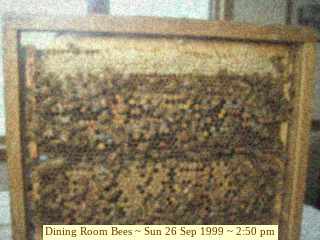
The BeeCam: a honeycomb behind glass, crowded with bees under a wide band of capped honey
LIVE FROM THE DINING ROOM. A new picture every ten minutes in daylight,
8 a.m. to 7 p.m. Eastern now that the days are getting shorter. The page reloads by itself.

They don't know they're on the Internet. I'm Ronald Strong. I sort mail at the processing plant here in Lexington, on the evening shift, which leaves my mornings for the bees. I've kept bees since 1991, when I took the beginners' course at the county extension office and came home with a veil and a smoker and a look on my face my wife still talks about. There are four hives along our back fence. The fifth lives in the dining-room window.

The camera is a Color QuickCam on a little tripod about a foot from the glass, looking straight at the upper frame. It's plugged into the family computer on the sideboard, and our son Adam, who is a junior at UK and knows about these things, found a program that grabs a picture every ten minutes and sends it up here. If it's dark out, there's no picture. Bees don't do much at night anyway, except fan their wings and make honey, which is a fair amount, come to think of it.

How to read the comb

  • Along the top, in an arch: capped honey, sealed under white wax. Right now, in late September, that band is wide. The goldenrod is in bloom along every fence row in Fayette County, and the bees are putting it away for winter.
  • Just below the honey: cells packed with pollen, in every color you can think of. Orange, bright yellow, gray, brick red. Each color is a different flower. The bright yellow-orange this month is goldenrod.
  • In the middle and lower part: the brood, the baby bees. Capped brood is tan and slightly domed, like the tops of little loaves. Open cells have white larvae curled in the bottom. The eggs are too small for the camera to see. A worker bee takes 21 days from egg to grown, and then she chews her way out of the cap.
  • Everywhere: the workers. All the bees you see are girls, except a few drones, which are bigger and have huge eyes. The drones get put out of the hive in the fall. Nobody said bees were sentimental.

How to find the queen
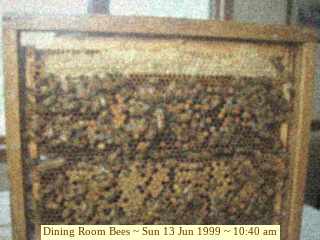
Look for a bee that's longer than the others, with a long tapering rear end, walking slowly, with a ring of workers around her facing in, feeling her with their antennae. Then look for the green dot. When I put her in, she came from a queen breeder in Georgia already marked on her back with a dab of paint. The color tells the year she was raised, and it goes in a five-year circle: white for years ending in 1 or 6, yellow for 2 or 7, red for 3 or 8, green for 4 or 9, blue for 5 or 0. Beekeepers remember it as Will You Raise Good Bees. In season she lays up to 1,500 eggs a day, so she doesn't come to the glass often, but when she does, people call each other.

The comb in June, with the queen in the middle: a longer bee with a green dot on her back, ringed by workers
Sunday, June 13, 1999, 10:40 a.m. She's just right of the middle, with the green dot, and her court around her. She stayed in front of the camera most of an hour.

The hive
I built it over the winter out of oak, two deep frames high, one above the other, with glass on both sides. It stands in the dining-room window. A clear plastic tube runs from the bottom of the case through a board I fitted under the raised sash, out to a landing board on the outside, so the bees come and go without ever being in the house. On a warm afternoon you can stand in the yard and watch them pour out of the end of that tube like they're late for something.

Inspection Log, 1999
Saturday, April 17 Stocked the hive with two frames of bees and brood from my strongest colony out back, and the new queen. The camera went on that afternoon.
Saturday, May 1 First new white wax along the bottom bar. They're settled.
Sunday, May 23 The first of the new queen's daughters chewing out of their cells, right on camera. Fuzzy and gray and confused.
Sunday, June 13 The queen at the glass for most of an hour. Saved the frame.
Saturday, July 10 Too crowded. Took out a frame of capped honey and put in empty comb, so they'd have room and not swarm. The honey went in the kitchen.
Saturday, August 14 First goldenrod pollen, bright yellow-orange. The whole dining room smells a little sour, which is the goldenrod nectar ripening. It goes away.
Sunday, September 19 Top frame nearly all capped honey. Lots of bees, less brood. Fall is coming and they know it before I do.

In October they go back outside
Two frames of bees can't make it through a Kentucky winter in a window. There aren't enough of them to keep the cluster warm, and they can't fly out on cold days to clean themselves. So on Saturday, October 16, if the weather's decent, I'll carry the whole case out to the yard and move both frames, bees and queen and all, into a full-size hive box with frames of honey from the others to see them through. The camera will go dark for the winter. Next April I'll bring two frames back in and start again. If you've enjoyed watching, now's the time.

A Word From Janet
When Ron said he wanted to put bees in the dining room, I said what any wife would say, which I won't put on the Internet. That was a year ago. I have made my peace with it. The room smells faintly of beeswax, and if you put your ear against the glass on a warm evening you can hear them humming, which is nicer than I expected. Exactly one bee has ever come into the house, on the back of Ron's sweater, and I caught her under a juice glass and put her out. At our Fourth of July cookout I had a yard full of guests and a grill going, and where was everybody? In the dining room, watching the glass. I'm told this is a conversation piece. I'm going to miss them in October, a little. Don't tell him.
-- Janet

Questions about bees, or about the window? Write me at [email protected]

Visitors to the hive:
002967
Last updated Sunday, September 26, 1999