 GeoCities.us
» Orchard » Patch
|
GeoCities.us
» Orchard » Patch |
Get your FREE home page! |
 |

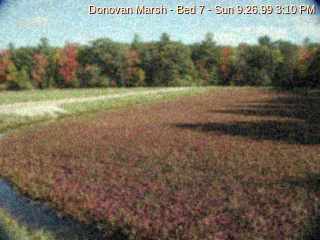 BED 7, LIVE. A new picture every ten minutes from 6:30 in the morning to 7 at night, Central time. The page reloads by itself every ten minutes. After dark you'll see the last picture of the day. |
|
Sunday afternoon, September 26. Bed 7 is about as red as it's going to get. The berries have colored up, the vines are loaded, and the red maples at the edge of the woods are just starting to go. Eight days until we flood the first bed. If you've been watching since June, you've seen the whole summer go by on this one little square of marsh. Stick around. The good part is coming. I'm Douglas Donovan. I'm 30, and I'm the fourth generation to grow cranberries on this marsh near Wisconsin Rapids, in the middle of Wisconsin. (Out east they call it a cranberry bog. Here it's a marsh, and each field is a bed.) We have 62 acres of beds. My great-grandfather Oliver Donovan built the first ones by hand in 1912, my grandpa Jesse ran it after him, and my dad Harold still runs it with me and bosses the harvest crew like he has for forty years. My wife Angelia keeps the books, and our son Christian is eight and thinks the water reels are the best thing ever invented. I put the camera up in June for two people. One is my brother Thomas, who is 27 and an Army specialist stationed in Germany. He grew up on these dikes, and this is another fall he'll miss. Germany is seven hours ahead of us, so he looks at it after supper over there, which is our lunchtime. Hi, Tom. The other is Christian's third-grade class. Mrs. Lorene Boylan pulls up the Marsh Cam on the classroom computer every morning, and the kids have been keeping a chart. Their questions are further down. |
|
What you're looking at
|
|
The cranberry year Winter. Once the ground freezes we flood the beds and let the water freeze solid, which protects the vines from the cold and the wind. Every few years we spread a thin layer of sand on top of the ice. When the ice melts in spring, the sand settles down onto the vines, which roots the runners and makes them put up new growth. Spring. We let the water off in April. Then come the frost nights. A cranberry marsh sits low and gets a lot colder at night than town does, and the new buds can't take a hard frost. So when it's going to get near freezing, we run the sprinklers all night. As the water freezes on the plants it gives off a little heat, and that holds the buds right at 32 degrees instead of letting them go lower. Nobody on a cranberry marsh sleeps much in May. Summer. The vines bloom in late June and early July, a pale pink flower that bends over and looks like the head and bill of a crane, which is where the old name "craneberry" came from. We rent honeybees from a beekeeper and set the hives along the dikes for the bloom. Then the berries set, little and green and hard, and spend the summer growing. 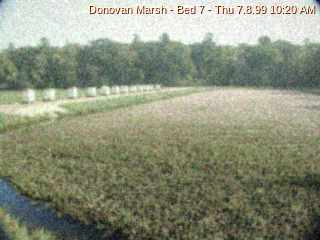 Saved frame: Thursday, July 8, 1999, 10:20 a.m. Full bloom. That pinkish haze is the whole bed in flower. The white boxes along the dike are the rented beehives. Fall. In September the berries color up from green to red. The frost nights come back too, and the berries have to be protected just like the buds were, right up until harvest. 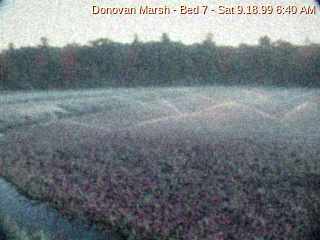 Saved frame: Saturday, September 18, 1999, 6:40 a.m. Dad and I were up all night running the pumps. That's the sun coming up through the spray, and that white on the dike is frost. The berries were fine. |
|
How a wet harvest works Cranberries don't grow underwater, whatever the harvest pictures make you think. The beds are dry all summer. We only flood them for winter and for harvest. Here's harvest:
|
|
Harvest 1999: the schedule Weather and trucks permitting. Each bed floods at daybreak and gets picked the same day. Bed 7 is Tuesday, October 12: watch the cam that morning and you'll see the water come up, then the reels, then the booms and the whole bed turning solid red.
No picking on Sundays. Grandpa Jesse's rule, and Dad's, and mine. |
|
A plain word about prices I'm not going to pretend. This is going to be a good crop and a bad year. The whole country grew a lot of cranberries the last couple of years, there are more berries sitting in storage than anybody can sell, and the price per barrel is way down from where it was two years ago. The talk at the coffee shop is that it goes lower before it comes back. Some of our neighbors put in new beds when prices were high and they're worried, and I don't blame them. We'll be careful, we'll fix what we can fix ourselves, and we'll get through it. Great-grandpa started this marsh in 1912 and got it through the Depression. We can get it through this. |
|
Grandma Orpha's Raw Cranberry Relish My grandma Orpha is 87 and still lives in the old house on the marsh. She's made this every Thanksgiving since before my dad was born. No cooking.
Put the cranberries and the orange through the old hand grinder, the coarse plate. (A food processor works, Grandma admits, if you pulse it and don't turn it into soup.) Stir in the sugar. Cover it and put it in the refrigerator overnight so the sugar melts and it sets up. It keeps a week. Grandma says to make it a day ahead or don't bother making it. |
|
Questions from Mrs. Boylan's Third Grade Do cranberries grow underwater? No! See "How a wet harvest works." The beds are dry most of the year. Why do they float? Four little air pockets inside each berry. Ask Mrs. Boylan to cut one in half for you. Are the bees yours? No, we rent them. The beekeeper brings them for the bloom and takes them home after. Why is it blank at night? The camera can't see in the dark, so it stops at 7 and starts again at 6:30 in the morning. Do cranberries taste good raw? They are SOUR. Try Grandma's relish instead. Can we come see the harvest? Yes. The whole class is coming out on Friday, October 8, to watch us pick Bed 5. Wear boots. Christian will be your tour guide, he says. |
|
How the Marsh Cam works: a small color video camera sits in the window of the pump house at the corner of Bed 7, looking out across the bed. A long cable runs from it to a video card in the computer in the farm office next door, and a shareware webcam program takes a picture every ten minutes, stamps the time on it, and sends it here over our second phone line. The camera is behind glass, so on frosty mornings the first few pictures are a little foggy until the pump house warms up. |


