 GeoCities.us
» Pentagon » Barracks
|
GeoCities.us
» Pentagon » Barracks |
Get your FREE home page! |
 |

 Back to Omaha Beach Normandy, June 1999 by Louis Flynt, as told to his grandson Dallas I came ashore on Omaha Beach on Wednesday, June 7, 1944, the day after D-Day. I was nineteen years old. Fifty-five years later my grandson took me back. He asked me to tell him what I saw, and he wrote it down, and this is it. A note from Dallas: These are Granddaddy's words, as close as I could get them. I typed while he talked at my kitchen table in Atlanta on a Sunday afternoon in August. Where I've added something, it's in italics like this. The pictures are mine. WHO I AM 1944 After the beach we followed the fighting across France and into Germany, building roads and bridges and taking out mines the whole way. My best friend in the outfit was Harry Kubiak, from Hamtramck, Michigan. He was killed in July of 1944, and he is buried in the American Cemetery above Omaha Beach. I came home in December of 1945, and I never went back. Not once in fifty-four years. WHY I WENT THURSDAY, JUNE 3, 1999 FRIDAY, JUNE 4 SATURDAY, JUNE 5 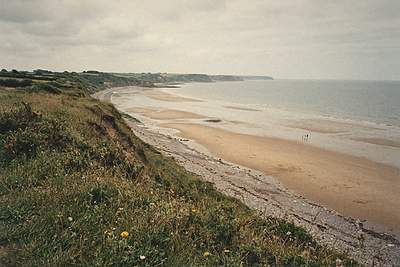 Omaha Beach from the bluff, at low tide. Granddaddy stood here a long time. —D. The tide was out. When the tide goes out at Omaha it goes a long way, and the sand is flat and wet and shining for what looks like half a mile. That I remembered. I remembered how far it was. It was quiet. A few people walking way out on the sand. Birds. Grass and wildflowers on the bluff where there wasn't any grass at all when I saw it last. That afternoon we drove west to Pointe du Hoc. That's the cliff the Rangers climbed with ropes and ladders on the morning of June 6, 1944, to get at the German guns on top. The ground up there is still all holes from the bombing and the shells, craters as big as a house, grown over with grass now, and pieces of broken concrete from the bunkers sticking up everywhere. They left it the way it was. I'm glad they did. 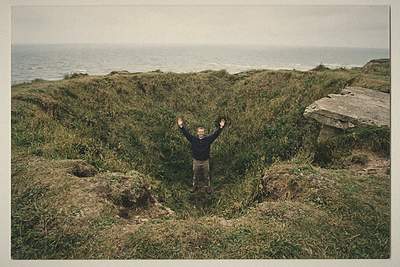 Me in one of the craters at Pointe du Hoc, for scale. Granddaddy wouldn't climb down, and he was right. —D. SUNDAY, JUNE 6 The cemetery is up on the bluff above the beach, at a place called Colleville-sur-Mer. There are more than 9,000 graves, white marble crosses and Stars of David, in rows so straight you can't believe it, on grass as green as a golf course. It is the most peaceful place I have ever been. 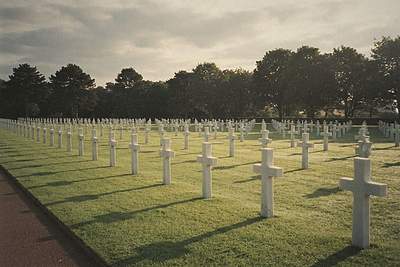 The American Cemetery at about 7:15 on the morning of June 6. —D. The people who work there looked up Harry for me and walked us out to him. I stood there a while. That's all I'm going to say about that. He said one more thing to Harry, quietly, and I'm not going to write it down. —D. MONDAY, JUNE 7 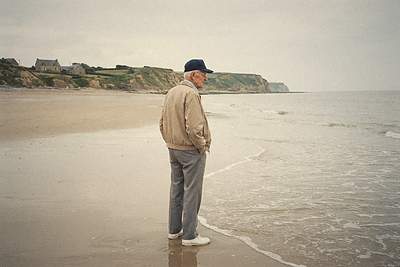 He stood there about twenty minutes. I took this one picture and put the camera away. —D. The water was cold, same as it was. Little waves coming up over my shoes. I got my shoes wet and I didn't care. There were children building something in the sand down the beach and a man throwing a ball for a dog. That's what we went for. That right there. TUESDAY, JUNE 8 They had us for lunch in their kitchen, an old stone house with a fireplace big enough to stand in. Mrs. Laurent, his daughter-in-law, cooked a roast of pork with apples, and there was bread and their own cider, and a round cheese from right there in Normandy, and coffee, and a little glass of apple brandy that about took the top of my head off. We were at that table three hours. Mr. Laurent doesn't speak English and I don't speak French. Dallas took French in high school and that helped some. Mostly we pointed and nodded. It worked fine. 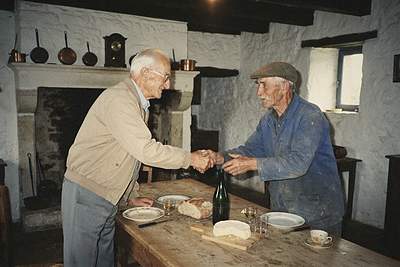 Granddaddy and Mr. Laurent at the end of lunch. Neither one would let go first. —D. When we left he shook my hand with both of his, and he said "thank you" in English. I believe he'd practiced it. I told him the same thing back, and I meant it more than he knew. They kept that country going for four years before we ever got there, and they cleaned it up after we left. WEDNESDAY, JUNE 9 THURSDAY, JUNE 10 WHAT HAS CHANGED WHAT HASN'T ABOUT THE WORD HERO For the record, here is what everybody knows: on June 6, 1944, American, British and Canadian troops came ashore on five beaches in Normandy. The Americans had Utah and Omaha. The British had Gold and Sword, and the Canadians had Juno. That was the start of the end of the war in Europe.     If you were there, or your father or grandfather was, I would be glad to hear from you. Write to Louis Flynt at [email protected] (Dallas reads them to him on Sundays.) Last updated Sunday, September 12, 1999 |