 GeoCities.us
» Pentagon » Parade
|
GeoCities.us
» Pentagon » Parade |
Get your FREE home page! |
 |

 ~ AN ACCOUNT OF ~ Four Days in Wool The 135th Anniversary Reenactment of the Battle of Gettysburg July 2 – 5, 1998 by James Pereyra, Private, Pennsylvania Volunteer Infantry, with photographs by Mrs. Frances Pereyra My name is James Pereyra. On weekdays I carry the mail in Harrisburg, Pennsylvania. On a good many weekends since 1988 I have carried a musket instead, as a private in a company that portrays one of the Pennsylvania volunteer infantry regiments of the Civil War. My wife Frances has come along since 1990. She portrays a civilian lady of the period, which in July means a cotton dress over a hoop, and she will tell you it is every bit as hot as wool. Last summer, for the 135th anniversary of the battle, we spent four days at the big reenactment on farmland outside Gettysburg. I have been to a lot of events. I have never seen anything like this one. There were more reenactors than any of us had ever seen in one place, North and South, foot, horse and guns, thousands upon thousands, and crowds of spectators along the rope lines every day. It was also brutally hot. Here is how it went. A word about the pictures: all of them are Frances's, except the one of her. Cameras stay in the tents when the ranks take the field (a camera on a private in 1863 would look a little odd), so she took the battle pictures from the spectator line, with everybody else. She did a fine job. Thursday, July 2 · Into Camp Friday, July 3 · Drill 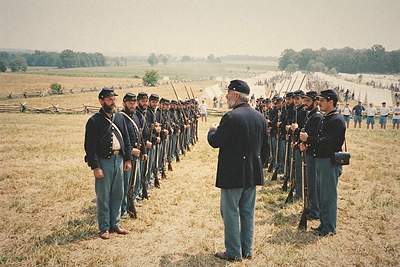 The company at shoulder arms, with First Sergeant Crosby facing us. I'm the bearded fellow at the near end of the front rank. In the afternoon we fought the first battle scenario. When the ranks take the field, all you see is the man next to you and the smoke in front, and all you hear is the officers and the guns. You fire blank charges, black powder and no ball, and nobody ever forgets that the musket is real. You march, you load, you fire, you wheel, and when the captain says it's time, some of you take a hit and fall down in the grass, which on a 95-degree afternoon is not the worst thing that can happen to a man. That night we sat around our mess fire, the four of us who share a cook pot and a coffee pot all season. 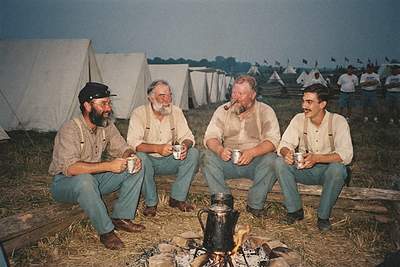 Our mess, left to right: me, Vern Crosby, John Trantham and Brandon Ressler. John is sixty, our company cook, and he can make a meal out of salt pork, potatoes and an onion that you'd pay for in town. He smokes a clay pipe and tells the same three stories every event, and we'd be disappointed if he didn't. Brandon is twenty-nine and the youngest in our mess, and he does most of the hauling of water, which is the privilege of youth. Vern you've met. The coffee is boiled in the pot with the grounds in it, and it is terrible, and I look forward to it all year. Saturday, July 4 · The Guns and the Heat 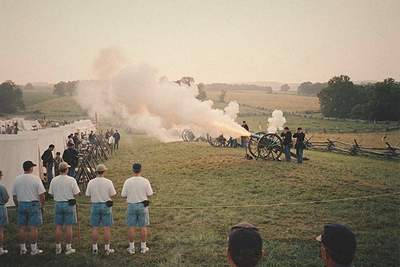 A battery firing, from the spectator line. You feel these in your chest at two hundred yards. We lost men to the heat that afternoon, in our company and every other. A man in wool, carrying nine pounds of musket, marching and running in the sun, can go from fine to flat on his back in five minutes. Four of ours went down before the battle was half over. The medics (real ones, with real ice and real water, waiting in the shade of the woods) took good care of them, and all four were back at the fire by supper, pale and embarrassed. The water details ran all day, buckets and canteens, and I drank a gallon of water that day and the next, and still came home five pounds lighter. If you ever go to a summer event, drink before you're thirsty, and wet your hat. Between battles I went over to the civilian side to see my wife, and found her on sutlers' row. The sutlers are the merchants who follow the army, then and now, selling everything from tin cups to shoes to candy, out of big canvas tents. It is very dangerous for a man's wallet. 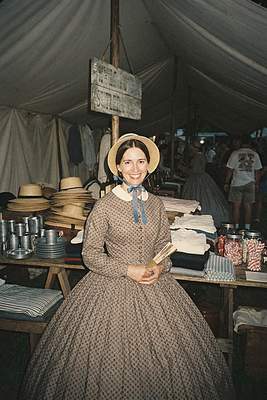 Mrs. Pereyra on sutlers' row. The one picture in the album I took. Frances made that dress herself, from a pattern of the period, in a small brown print that's correct for 1863. The hoop underneath is steel. She bought a new fan that afternoon and a tin cup for me. I bought nothing, which she says is a first. Sunday, July 5 · Service, and the Last Battle 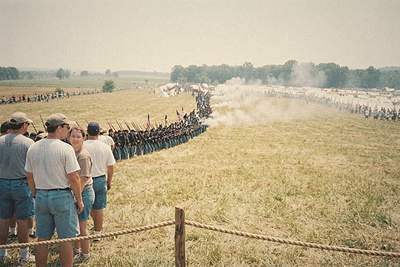 The Union line advancing across the hayfield. Our company is in there somewhere. From inside the line you don't see it like this. You see the back of the man in front of you and the colors moving over your head, and you hear the drums. When Frances showed me this picture I looked at it for a long time. That is what it must have looked like. That's the whole reason we do it. We struck our tents at five and were home in Harrisburg by nine. I slept eleven hours, and went back on my route on Monday with a farmer's tan that stopped exactly where my collar did. What a Private's Kit Weighs and Costs
As for weight: the musket runs about nine pounds. With the full kit on, blanket roll, canteen full, haversack and cartridge box, I weighed myself on the bathroom scale once, and it came to thirty-four pounds over what I weigh in my postal uniform, before the wool gets wet with sweat. The real soldiers carried more, and marched farther, and slept on the ground with no air mattress waiting in the trunk of the car. We never forget that. The Real Battle, July 1–3, 1863 How to Join a Unit
Visitors to this page since March 1999:    
Questions about reenacting, or about the battle? Write to me. Last updated Monday, September 6, 1999 |