GeoCities.us
» Petsburgh » Yard
|
GeoCities.us
» Petsburgh » Yard |
Get your FREE home page! |
 |

 The Racing Pigeon LoftCam
|
|
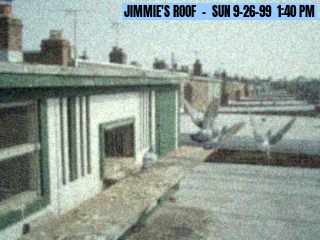
TODAY - SUNDAY, SEPTEMBER 26, 1999 The 200 mile young bird race. The birds were let go at 8:30 this morning in Virginia. Wind in their faces all the way. A slow day. My first bird hit the clock at 1:31 PM. That is about 1,170 yards a minute. At 1:40 three more came in together. You can see them on the picture. The club opens the clocks tonight. I will put the result here Monday. |
|
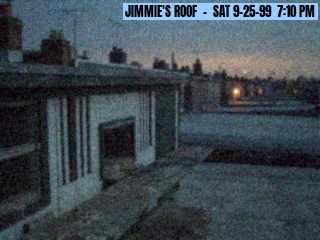
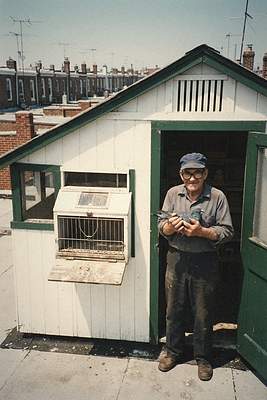
HELLO My name is Jimmie Valentin. I am 75 years old. I was born in 1924 on the same block where I live now. I worked 34 years at the Philadelphia Navy Yard as a pipefitter. I started in 1955 and retired in 1989. I have raced homing pigeons since I was twelve years old. That was 1936. A man named Stanley Bouchard lived down the block. He ran a trolley and kept birds on his roof. I used to sit on our step and watch them go around. One day he gave me a pair of blue bars and told me to keep them locked in for three weeks so they would learn where home was. I did. I have had birds ever since, except for the Army. Right now I have about 60 birds. Old birds and this year's young birds. THE LOFT The loft is on the roof. I built it myself. The first part, with the peak on top, I built in 1962. The long part with the landing board I put on in 1975. You go up a ladder through the skylight in the back bedroom. Some days my knees will not take the ladder. That is why we have the camera. THE CAMERA My grandson Jeremy Champagne put it up on Saturday, May 22. He is 22 and studies engineering. He is my daughter Sherry's boy. The camera is a little one made for watching a driveway, in a metal box so the rain can't get in. He strapped it to the chimney looking across the landing board. The wire comes down through the skylight to the computer on the kitchen table. Now I can sit in the kitchen with my coffee and see who is home. The fellows from the club look at it too. They like to see whose birds beat whose. I like to see that also. HOW A RACE WORKS People ask me this. Here is how it goes.
A good day is 1,400 or 1,500 yards a minute. With a wind behind them it can be more. With a wind in their faces, like today, it is a lot less. YOUNG BIRD RACES - FALL 1999 These are the birds hatched this spring. All races on Sunday.
WHAT THEY EAT A racing pigeon is an athlete. You feed it like one. I give them a mix of peas, corn and safflower, with some wheat and milo in it. Peas for muscle. Corn and safflower for the long flights, because they burn the fat. Less in the middle of the week, more on Thursday and Friday before a race. Grit in a dish so they can grind the seed. Fresh water every single day, no matter what. I don't care if it's Christmas. THE HAWKS Every pigeon man in the city will tell you about hawks. Cooper's hawks come right over the roofs and take a bird off the board. And there are falcons now that nest on the bridges over the Delaware. A falcon comes down so fast you never see it. Just feathers. I lost five young birds this year. That is part of it. You don't have to like it. THE ROOFS When I was a boy you could stand on our roof and count the lofts. It seemed like every third roof on the block had one. On a Sunday evening the sky over South Philly was full of birds, everybody's kit going around together, and you had to know your own. Now there are three lofts in the whole neighborhood. Mine and two others. The young fellows have other things. I understand that. But I miss the sky the way it was. MORE PICTURES
RUTH My wife Ruth and I were married in 1949. She passed away in 1996. In 47 years she never once went up that ladder. She said if God wanted her on the roof He would have made her a pigeon. When supper was ready she would knock on the bedroom ceiling with the broom handle, three times, and I would come down. But every race Sunday she would ask me the same thing. "Did they come home?" She kept every race sheet in a shoe box in the closet. I still have the box. Most of them come home, Ruthie. |