 Nine Days in the Ice
Watertown, New York · January 7 to 16, 1998
My name is Sue Dorman. My husband Delbert and I live in an old farmhouse on the edge of Watertown, in
Jefferson County, up in the northern corner of New York State, where we get plenty of snow every winter and
think nothing of it. In January 1998 we got something else. For five days it rained, and the rain froze on
everything it touched. We were without electricity for nine days. Some of our neighbors went longer.
I kept notes in a spiral notebook by lamplight because it seemed like something I ought to remember,
and I took pictures with my little camera. The film sat in the camera until February, when I finally took
it to the drugstore. This page is the notebook and the pictures, typed up for anyone who wants to know what
it was like, and for my sister in Arizona, who keeps asking.
|
What is an ice storm? It isn't a blizzard. It's rain, falling through a layer of freezing air close to
the ground, so that every drop freezes the instant it lands. Every branch, twig, wire, fence and blade of grass
gets a coat of clear ice, and the coat gets thicker every hour it keeps up. Ice is heavy. A branch that holds
up fine under a foot of fluffy snow will snap under an inch of ice, because snow blows off and ice doesn't.
Birches bend over until their tops touch the ground. Maples, which are brittle and spread out wide, break.
Power lines sag, then snap, and when the trees fall on them, they take the poles down too. In January 1998
it happened across northern New York, northern New England and up into Quebec, all at once.
|
Monday, January 5
Rain all day, just above freezing, then just below. The radio says freezing rain warning. The walk was
glazed by supper and Delbert put down salt.
Tuesday, January 6
Still raining. Everything is coated. School is closed, the clinic is open, and I slid most of the way there.
The trees make a sound in the wind like wind chimes made of glass. At night we heard the first limbs come
down out back. The lights flickered twice.
Wednesday, January 7
Power went out at 4:20 this morning and the house went quiet: no furnace, no refrigerator, no well pump. We
have the woodstove in the kitchen, thank the Lord, and plenty of wood. Delbert was called out at seven. He
repairs milking equipment for a living, and every dairy farm in the county is without power, and cows have to
be milked twice a day whether there's electricity or not. I filled the bathtub with what water was left in the
pipes.
Thursday, January 8
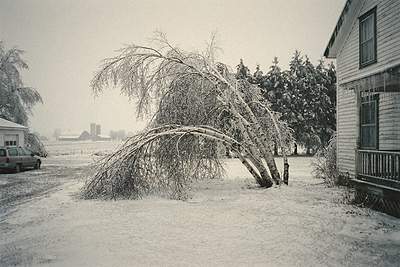
The birches in the back yard are bent right over to the ground in arches, frozen in place. I have never seen
anything like it.
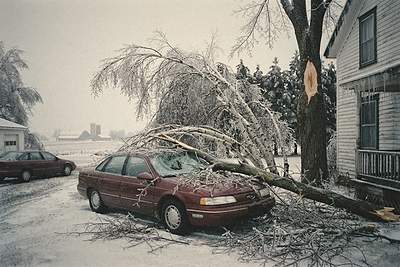
This afternoon the big maple by the driveway let go of a limb as thick as a man's waist, right on top of my
car. The windshield is gone and the hood is caved in. I was in the kitchen and heard it, a crack like a rifle and
then a long crash. Better the car than the roof. Better the car than Delbert.
All night long the limbs came down, all around us, in the dark. It sounds like gunshots. You lie there under
four blankets and count them.
Friday, January 9
I walked out to the road this morning. The poles are down. Two of them are snapped clean off, and the lines are
lying across the road and the snowbank, thick with ice. Nobody's going anywhere on our road for a while. The
battery radio says the whole north country is dark, and the Governor has called out the National Guard.
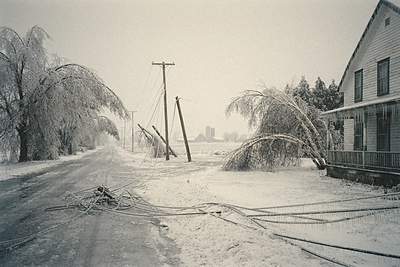
Please, if you ever see a downed line, stay away from it. You can't tell by looking if it's dead.
Saturday, January 10
The rain finally quit. Our son Tom drove up from Syracuse, where the storm hardly touched them, with a generator
in the back of his truck that he borrowed from the contractor he works for. He's my hero for the rest of his life.
Ron and Luella Holtzman next door came over too. Their house was down to 41 degrees, and Ron is 63 with a bad
heart, so they slept on our living room floor by the stove for four nights, and Luella and I took turns cooking.
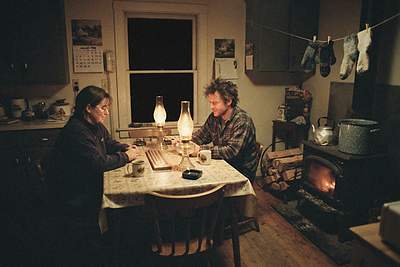
That's Tom and me playing cribbage by the oil lamps Saturday night. Delbert took it with the flash turned off
so it would look like it really did. The stockpot on the woodstove was chicken soup, and the socks over the
stove were everybody's. Tom skunked me twice.
Sunday, January 11
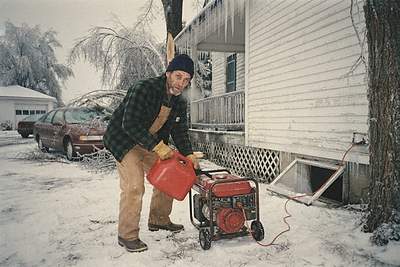
We ran the generator a few hours at a time: the furnace blower, the refrigerator, the well pump, then off, to
make the gas last. Gas was hard to come by. The stations that had power had lines down the block. Here's Delbert
filling it up in the snow beside the house. He'd been up since four at a farm out past the river and hadn't
slept more than three hours a night all week, which is why he looks like that.
The farmers had it hardest. A dairy cow has to be milked, every twelve hours, no matter what, or she gets sick.
Some farms had their own generators and some didn't, and the generators that came in by truck from other states
went to farms first. Delbert went from one to the next, getting milking systems and bulk tanks running on
borrowed power. Some farms milked by generator and still had to pour the milk out, because the trucks couldn't get
down the roads to pick it up. I don't think people who don't farm will ever know what those families went
through.
Monday, January 12
Tom went home. On his way out he counted bucket trucks from four other states on the main road. The line crews
came from all over to help us, working sixteen-hour days in the cold. When I see a lineman now, I want to buy him
a cup of coffee.
Tuesday, January 13
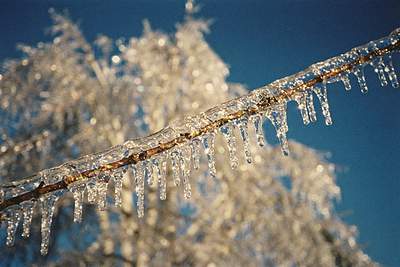
The sun came out this morning for the first time in a week, and I have to tell you, it was the most beautiful
thing I have ever seen. Every tree, every wire, every weed in the field was made of glass and lit up like a
chandelier. You could hardly look at it. I stood in the yard and cried, partly at how beautiful it was and partly
at what it had done.
Wednesday and Thursday, January 14 and 15
Chain saws, everywhere, all day, every direction. The road crews cleared our road Wednesday. The Holtzmans' son
came and got them Thursday and took them to his place down south of us, where the power was back. The house seemed big
and quiet without them.
Friday, January 16
3:15 in the afternoon, the refrigerator hummed. I thought I was hearing things. Then the furnace kicked on, and I
went and stood over the register like it was a campfire. Nine days. That night I took the longest hot shower of
my life.
Our Storm Box
After the power came back, I went and bought a big plastic tub with a lid, and it lives in the back hall now.
Here's what's in it. With all the talk about Y2K, people ask me if I'm ready for New Year's. I've been ready since
January 1998.
- Two kerosene lamps, spare wicks and chimneys, and two gallons of lamp oil
- Three flashlights and a whole bag of batteries
- A wind-up radio, so we don't need the batteries for news
- Candles and kitchen matches in a coffee can
- Canned soup, stew, beans, tuna and peanut butter, and a hand can opener
- A two-burner camp stove and fuel
- Six gallons of water. (With a well, no power means no water. You forget that until you need it.)
- Wool socks, two old sleeping bags and the good afghan
- A first-aid kit and a week of Delbert's blood pressure pills
- Some cash, because the bank machines don't work without electricity either
- A deck of cards and the cribbage board. Very important.
And Delbert keeps the gas cans full, and we have our own generator now. Tom took his boss's back in February.
This Summer
People ask about the trees. The birches surprised me. Most of them stood back up by themselves over the spring,
a little bowed, but they're alive and they leafed out fine. The maples along the road were another story. Half of
them were too broken to save, and the town took them down in April. The big one by the driveway, the one that got
my car, lost its top and two big limbs, but it leafed out in May, lopsided, and this summer it gave us shade
on one side of the driveway. Delbert says it'll fill in. I say we'll see. We planted three young sugar maples
along the road in May, so somebody will have shade there in thirty years.
If you went through the ice storm too, here or in Vermont or Maine or Quebec, I'd like to hear about it.
Visitors since March 1999:
    
Sue Dorman · [email protected]
Last updated Sunday, August 29, 1999
|
 GeoCities.us
» RainForest » Canopy

