 GeoCities.us
» RainForest » Mountains
|
GeoCities.us
» RainForest » Mountains |
Get your FREE home page! |
 |

|
October 8 to 11, 1998 
My dear Christina and Paul, Your Grandpa Herbert tells me that this letter will stay on the computer for as long as anyone wants to read it, which is longer than I can promise to stay myself. So I am writing it to you now, while you are six, for you to read when you are older and perhaps curious about the old lady who used to give you butterscotch candies. Last October, the week after my eighty-fifth birthday, Herbert drove me up to Vermont to see the maples once more. That was his birthday present to me. I was born on a hill farm in Vermont in 1913, and I taught my first school there, in a little village in the Green Mountains, before I married your great-grandfather Clarence and came down to Springfield. I had not been back in the fall for many years. I wanted to see the color one more time, and I wanted to see my schoolhouse. Herbert took the pictures and put them on this page for me, but every word is mine. He is not allowed to fix my commas. Thursday: The Road North 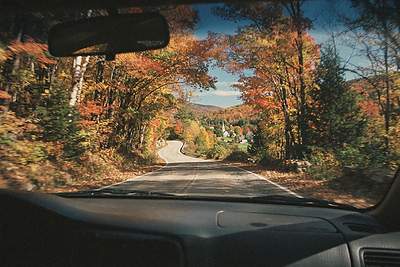 Route 100, through the windshield. Herbert took this one while he was driving, and we had words about it. We left Springfield on Thursday morning and drove up into Vermont and onto Route 100, which runs north through the middle of the state along the valleys, between the mountains. By noon the color was all around us. In some places the trees came together over the road and we drove through a tunnel of orange and red with the sun coming through it in pieces, and I could not say anything at all, which Herbert says is a first. We stayed three nights at a bed-and-breakfast in an old farmhouse kept by Russell and Joan Humphrey, who gave me the downstairs bedroom so I would not have to climb the stairs, and made blueberry pancakes every morning, and let me sit on their porch in the afternoons with an afghan over my knees. I recommend them, and I recommend the afghan. The Colors, Tree by Tree I want you to know what you are looking at, because when I was a girl my father taught me, and somebody ought to teach you. The sugar maples are the glory of it. They turn orange, and then a deeper orange, and some of them go all the way to scarlet, and one tree can be all three at once, green inside and fire on the outside. They are the trees we tapped for syrup in March when I was your age. The red maples in the wet places turn the brightest red of all, early, before the others. The birches go a clear yellow, like butter, against their white bark, and the beeches a paler yellow that turns to bronze. And all through the hillsides, holding the whole thing together, are the spruce and fir, dark green, almost black, which never change at all. Without them it would be too much. That is something I have found to be true about a good many things. Friday: Farms and Bridges 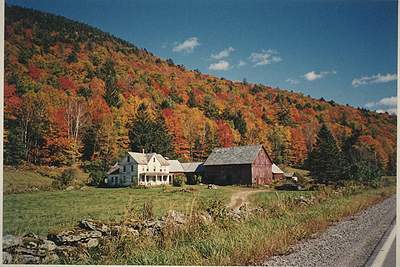 A farm along the road, Friday morning. The farm I grew up on looked very much like this, but poorer. On Friday we drove the back roads. Every farm we passed had a white house and a red barn and a stone wall, and every one of those stones was put there by hand, by some farmer clearing his field a hundred and fifty years ago, one stone at a time, with an ox and a stone boat. My father built walls like that. When you see a stone wall running off into the woods, children, it means there was a field there once, and somebody's whole life went into it. 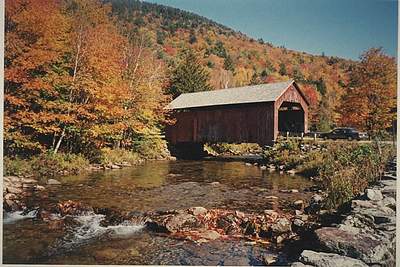 A covered bridge over a brook, with the leaves floating down. Then the covered bridges. People ask why they put roofs on them. It was to keep the weather off the big timbers underneath, so the bridge would last; a bridge left out in the rain and snow rots, and a covered one stands for a hundred years. When I was a girl we called them kissing bridges, because it was dark inside and a young man could steal a kiss. I will say no more about that. We stood on the bank for a long time and watched the leaves come down the brook, red and yellow, turning in the little whirlpools behind the rocks. Saturday: The Cider Mill and My Schoolhouse 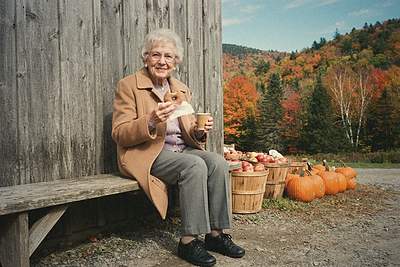 Your great-grandmother, with a very good cider doughnut. On Saturday morning we went to a cider mill, an old gray barn where they press the apples right in front of you, and the whole place smells of apples and woodsmoke. They sell cider doughnuts there, warm, rolled in sugar. I had one and pronounced it very good. Then I had half of another one, which is not in the picture. You will notice I am wearing my good coat. I thought about that before I sat down with a sugared doughnut, and decided I am eighty-five and it is my coat. That afternoon we went to Ransom Hollow. That is the village where I taught my first school, in the fall of 1935, when I was twenty-one years old and had just finished at the normal school. It was a one-room schoolhouse with a wood stove and fourteen pupils in eight grades, and I boarded with a farm family a mile up the road and walked down every morning in the dark in winter to start the fire before the children came. I taught there four years. Some of those children were nearly as tall as I was, and one of the big boys could not read when I got there and could when I left, and I am prouder of that than of anything else I did in all my years of teaching. The schoolhouse is still standing. It is somebody's home now. They have put on a new porch and painted it yellow, and there is a little satellite dish on the roof. The lady who lives there saw an old woman standing in the road staring at her house and came out to see what was the matter, and when I told her, she took me inside and let me stand in her front room, which was my classroom. The wood stove is gone. The windows are the same. I could see exactly where my desk was. Herbert took a picture of the house, but I asked him not to put it here, because it is that lady's home and not mine anymore. You will have to take my word for it. Sunday: Church, and Home 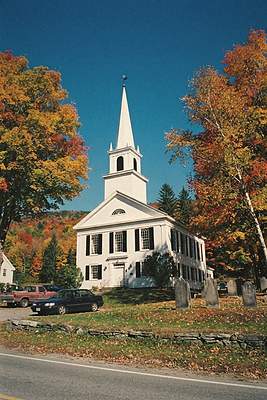 The church where we went to service on Sunday morning. On Sunday morning we went to service at a white church on a little green, with a steeple you could see from two miles away. They sang the old hymns, the ones I know without the book. The people there were very kind to two strangers, and after the service an old gentleman about my age wanted to know who my people were, and it turned out he had known a cousin of mine. That is Vermont for you. Then we drove home to Springfield, and I slept most of the way, with the color going by outside the window. On Traveling at Eighty-Five Your Grandpa Herbert asked me to put down my advice, in case any of my friends at church want to try it. Here it is.
I have had a long life and seen a great deal, children, and I want you to know that four days of looking at trees with my son was one of the very best parts of it. When you are grown, take somebody you love to see something beautiful. Do not wait for a better time. This was the better time. With all my love,    times. Herbert says that is a great many people. I say it is a great many times Herbert has looked at it. If you would like to write to me, Herbert will print your letter and bring it over: [email protected] Last updated Sunday, August 29, 1999 |