GeoCities.us
» RainForest » Mountains
|
GeoCities.us
» RainForest » Mountains |
Get your FREE home page! |
 |

 From our veranda on the ridge at Tagaytay, Cavite, Philippines,
| The short answer: No. Not today, and not where our camera can see. The longer answer is below, together with a good deal of explanation, because I was a schoolteacher for 34 years and I am not able to stop now. |
|
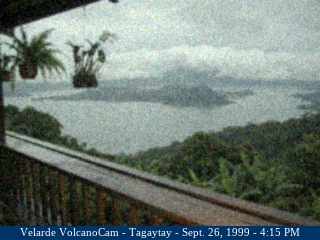
| Sunday, September 26, 1999, 4:15 p.m. It rained hard after lunch, as it often does in September. You will notice that the clouds are lifting off the lake in rags and the island has come out from under them, dark and clear, while the mountains on the far shore are still wearing a lid of cloud. |
|
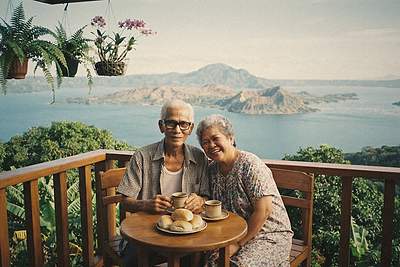
Concerning old pictures. If the time printed on the picture is an hour or more behind your clock, nothing is broken. Our computer sends the picture over the same telephone line we use for talking, and it cannot dial while someone is on the telephone. In this house "someone" means my wife, Lourdes, and "on the telephone" means with her sister. So an old picture is a perfectly reliable instrument. It tells you that Lola is on the phone. You will notice that the picture above says 4:15 and not 4:00. I rest my case. Who We Are My name is Gregorio Velarde. I am 66 years old. I taught physics at a public high school in Quezon City for 34 years and retired in 1995. My wife, Lourdes, is 65 and is a retired public health nurse. We were married in 1958, which our grandchildren regard as ancient history. I have explained to them that it was in this very century, and that the century is not over until the end of 2000. They did not laugh, but I did. In 1996 we sold our house in Quezon City and moved up here to a small house on the ridge in Tagaytay, on the side that faces the lake. The house is nothing special. The veranda is. It is a plain wooden veranda that looks south over Taal Lake to Volcano Island, and we spend most of our mornings on it. Lourdes says we retired to the veranda and the house came with it. Our daughter, Merly Velasco, lives in Parañaque and drives up most Sundays with her family. Her eldest, our grandson Ruel Velasco, is 20 and in his third year of computer engineering in Manila. He is the reason this page exists.
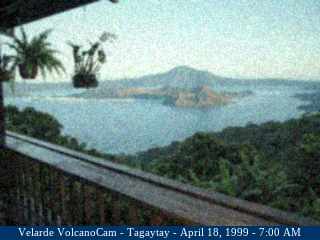
The Camera Ruel set the camera up on Saturday, April 17, 1999, during his summer vacation. It is a small color camera, about the size of an egg, and it sits on the sill of our sala window looking out across the veranda railing to the lake. A wire runs from it along the floor to the family computer, a beige Pentium with a 56K modem, which we bought so the grandchildren would have something to do when they visit. Now the computer works harder than either of us. Every half hour, from six in the morning to six in the evening, the computer dials the Internet by itself and sends the newest picture to this page. At night it rests, which is more than I can say for the frogs. Ruel wrote down every step of updating this page on an index card, which is taped to the side of the monitor. I would like it known that I have needed the card only twice. What You Are Looking At I have drawn you a small diagram, as I would have on the blackboard. Compare it with the picture at the top of the page.
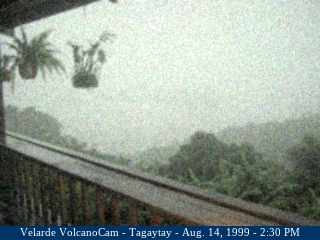
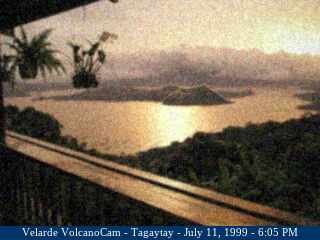
(A) My wife's ferns and her orchid basket, which hang from the eaves of the veranda. They are not volcanic. They are, however, the best-watered plants in Cavite. (B) The hills and mountains on the far shore of the lake. In the rainy months they are usually wearing cloud. Many visitors have written to tell me that the tall mountain behind the island is the volcano. It is not. It is only a mountain, standing on the far shore. Which brings us to: (C) Volcano Island. This is the volcano. It is the low, rumpled, brownish-green island in the middle of the lake, the one that does not look like a volcano at all. Visitors from abroad expect a tall cone with a point on top, like a child's drawing. Taal does not oblige. (D) Taal Lake. More about it below. (E) The treetops and banana plants on the slope just below our house. The ground drops away very steeply past the railing, so these are the tops of trees whose feet are a long way down. (F) Our veranda railing, plain varnished wood. When it is dark and shiny, it has rained. That is the only weather instrument on this page, and it is a very good one. A Little Geology, from a Physics Teacher I taught physics, not geology, so I will keep to what is well known and leave the rest to the experts. Taal Lake fills a huge old crater, what the geologists call a caldera, made by eruptions long ago. You will notice that the lake is very large. That gives you some idea of how large those eruptions were. Volcano Island, in the middle of the lake, is the volcano you can see. It has a lake of its own inside its crater, which you cannot see from the ridge. So we have a lake, inside an island, inside a lake, inside an old crater. I used to draw this on the board for my students as a set of circles, one inside the other, and the boys in the back row would finally wake up. People like to say that Taal is one of the smallest active volcanoes in the world. I report this as something people like to say. It is certainly small, and it is certainly active, and I would not argue with it on either count. Its history, briefly. The eruption of 1911 killed more than 1,300 people. The eruption of 1965 killed about 200. The last eruption was in 1977. Since then it has been quiet, though I will remind you, as I reminded my students, that "quiet" is a relative word when you are speaking of a volcano. The government's volcanologists keep watch on it. We keep watch on the volcanologists. If ever they say there is something to worry about, Lourdes has said she will pack at once, and I have said I will help her, as soon as I have taken one more picture. So: is Taal smoking? Not that we can see from here. But you will understand now that the crater is out of our sight, and that a camera on a windowsill is no substitute for the people whose work it is to know. Our camera is for looking. For knowing, read the newspaper. The Lake The lake has a fish found nowhere else, the tawilis, a small sardine that lives only in Taal Lake. A sardine that lives in one lake and nowhere else is exactly the sort of thing that made me want to be a science teacher in the first place. Lourdes fries them crisp and we eat them whole, and I lecture about them while she does it, and she lets me. Near the shore you can see the fish cages where tilapia are raised. From the veranda they are little specks in rows on the water. I can count them when the air is clear and I have my glasses on. The camera, which has no glasses, mostly cannot, so you will have to take my word for it. The Weather, or Why the Picture Is White From June to October, the clouds come down on the ridge most afternoons. When that happens, the lake, the island and the far mountains disappear entirely, and the camera sees only a white wall. A white picture is fog, not a broken camera. I have answered this question by e-mail 41 times, and I am putting it in bold type in the hope of not answering it a 42nd. From December to April the weather is clear and cool. Those are the months to look, and those are the months to come up, if you are coming. The mornings are best of all.
Tagaytay on a Weekend On Saturdays and Sundays a good part of Manila drives up the ridge road for the cool air, to stand at the railings and look at the lake, eat, and drive home again. On a weekday the town is quiet. On a Sunday afternoon it can take a long while to go a short way. Along the ridge road you will find bulalo, the beef soup with the marrow bones, in big bowls, and it is the right thing to eat on a cold, foggy afternoon. We go on a Tuesday, when we can find a table. Every morning, on the veranda, we drink kapeng barako, the strong Batangas coffee. It is very strong. Our son-in-law tasted it once and has brought his own coffee ever since. Lourdes takes hers with a great deal of milk. I take mine black, as a matter of principle, and I am up before the camera is. Letters from Our Visitors We have had more letters than I expected, from more places than I expected. I answer every one, though not always quickly. Here are a few, without names, because I did not ask permission to print names and a teacher does not embarrass his pupils in public.
If you write, please tell us where you are. We keep a map.
     since the camera went up on April 17, 1999  Write to us: [email protected] If we are slow to answer, you know why. Last updated Sunday, September 26, 1999 (The writing, that is. The picture updates itself.) Gregorio and Lourdes Velarde, Tagaytay |