 GeoCities.us
» RainForest » Wetlands
|
GeoCities.us
» RainForest » Wetlands |
Get your FREE home page! |
 |

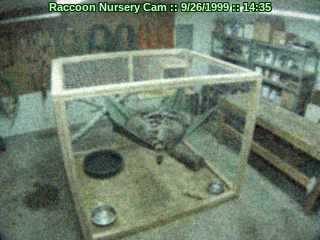 Live from the garage. A new picture every five minutes, day and night. This page reloads itself every five minutes. |
| Sunday afternoon: asleep, all of them, in one pile in the hammock. Count them if you can. I find four faces and a tail. Number 3 is on the bottom, as usual. Raccoons sleep most of the day, so if you're looking in the daytime this is pretty much what you'll get. The nights are the show. Come back after dark (Central time), or see the best frames. |
|
Who's watching I'm Donna Berning. In the daytime I'm a veterinary technician at a small-animal clinic here in Columbia, Missouri, and since 1993 I've also been a licensed wildlife rehabilitator: people bring me orphaned and hurt wild animals, and I raise them or patch them up and put them back where they belong. Mostly squirrels, rabbits, opossums, a few songbirds, and every spring, raccoons. Why a camera? |
|
The five, by number Numbers, not names, on purpose. A name makes it a pet. These are not pets. #1, #2 and #3 came out of a chimney on the east side of town in May. Their mother went out one night and never came back, and after two days of crying in the flue the homeowners called the conservation office, which called me. #4 and #5 came a week later. Their mother was hit crossing the highway north of town, carrying one of them in her mouth, the way a mother raccoon moves her babies. The man who stopped found that one beside her and the other in the grass on the shoulder, and he drove them both to my clinic in a shoebox. Bless him.
|
|
From bottles to crayfish When they came in they were about two weeks old, eyes shut, about the size of a baked potato. They lived in a plastic tub on a heating pad on Howard's workbench and got a bottle of puppy milk replacer every three to four hours, around the clock. My husband Howard took the 2 a.m. feeding. Their eyes opened in the second week of June (that's the very first camera frame, on the best frames page). At about seven weeks I started them on a mush of formula and soaked puppy kibble, and they wore more of it than they ate. Then dry kibble, fruit (grapes are the favorite, melon second), boiled eggs, corn on the cob, and live crayfish from the creek, so they learn to hunt for their supper. You'll see them at the water pan at night, feeling around in it with their front paws. Raccoons do that with their food whether it needs washing or not. The cage At night the garage lights are off and a clamp lamp with a red bulb stays on. They don't seem to mind red light, and the camera can just about see by it, which is why the night pictures look like they were taken on the planet Mars. |
|
Going home In early October, when they're about five months old, they go to my friend Sharon Lamphere's farm north of town, which has woods, a creek, and no near neighbors. It's a soft release: one evening we carry them out in their travel cage, set it down at the edge of the woods by the creek, and open the door. For a few weeks I'll leave food there, less and less, while they figure out the creek has more crayfish in it than I do. Some nights they'll come back to the cage. Then one night they won't. That's the good night. When they're gone, the camera goes off till next spring. |
If you find a baby raccoon
|
|
See the best frames Nursery visitors since June:     
Questions? [email protected] (If you've found an animal, call a rehabber near you first. E-mail is too slow.) Last updated Sunday, September 26, 1999 |