|
I'm Willie Voigt. I'm 19, I'm from Fort Dodge, Iowa, and I'm a sophomore in meteorology at the University of Oklahoma
in Norman. I've wanted to see a tornado since I was seven and one went through a farm two miles from my grandparents' house.
(Nobody got hurt. The barn didn't make it.) This spring, my freshman year, I finally went chasing for the first time, with my
classmate Kristopher Wooten, who is 20 and from Amarillo, in Kristopher's old maroon four-door. It has about 160,000
miles on it and an air conditioner that works when it feels like it.
Here's the honest truth about chasing: most days you don't see anything. You drive 400 miles, sit in a gas station parking
lot for three hours staring at the sky, watch a few clouds go up and fall apart, and drive home. That's a bust. When it works, it's
a boom. We had both.
THE LOG
| DATE |
TARGET |
MILES |
WHAT WE SAW |
VERDICT |
| Fri 4/23 | Woodward, OK | 360 | Towers went up at 4, got torn apart by the wind up high, gone by 5. | BUST |
| Sat 5/1 | Clinton, OK | 280 | Our first supercell. One storm all by itself at sunset, stacked like plates. | BOOM |
| Sun 5/16 | Medicine Lodge, KS | 500 | A wall cloud, rotating, over a red dirt road. It never put anything down. | BOOM |
| Sat 5/22 | Childress, TX | 420 | Capped. Nothing went. Ate barbecue. | BUST |
| Sun 5/30 | Clarendon, TX | 600 | THE TORNADO. A thin white rope over empty ranchland, miles away, about four minutes. | BOOM!!! |
| Tue 6/1 | Elk City, OK | 300 | One long line of storms. All rain, lightning and wind. | BUST |
| Sat 6/5 | Dodge City, KS | 640 | Golf ball hail. On us. See below. | BOOM (on us) |
| Sat 6/12 | Pratt, KS | 480 | Storm fell apart. Then the best mammatus sky of our lives. | PRETTY BUST |
| Fri 6/18 | Altus, OK | 260 | Nothing. Last chase before Kristopher went home to Amarillo for the summer. | BUST |
| TOTAL: 9 DAYS | 3,840 | 4 booms, 5 busts, 1 tornado |
Miles are from Norman and back, off the odometer. Kristopher's car eats about a tank every 300 miles,
and we split the gas.
THE PICTURES
All off my 35mm, which prints the date in the corner so I can match every picture to the log.
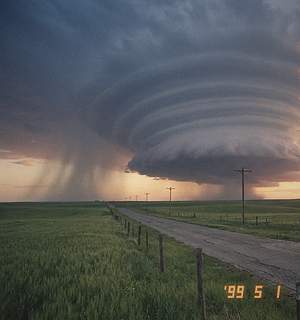
Saturday, May 1, west of Clinton, Oklahoma.
Our first supercell, and still the best thing I've ever seen. One storm by itself, over green wheat, with the sun going
down behind it. Those bands on the side are called striations. The whole thing is turning, and you can see it in the way it's stacked.
We sat on the side of the road and didn't talk for about twenty minutes.
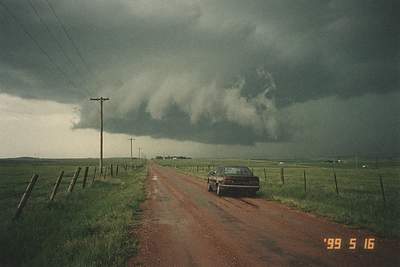
Sunday, May 16, north of Medicine Lodge, Kansas.
A wall cloud: the lowered block of cloud under the back of the storm, where the updraft is pulling in warm, wet air.
This one was turning slowly and we were sure it was going to do something. It didn't. We watched it for half an hour from this dirt
road, with a way out to the south behind us.
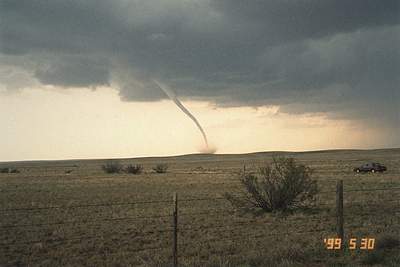
Sunday, May 30, Texas Panhandle, southeast of Clarendon.
THERE IT IS. A thin rope tornado, way off over empty ranchland, touching nothing but grass. It lasted maybe four minutes.
We were miles away and that is exactly where I want to be. I yelled so loud Kristopher made me get back in the car. This is the best kind
of tornado there is: far away, over nothing, and gone.
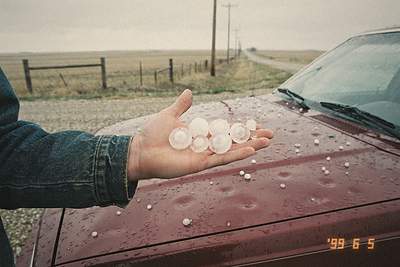
Saturday, June 5, south of Dodge City, Kansas.
Golf balls. We were sitting on a county road watching a storm to our northwest, a safe distance away, when a new storm
built right over the top of us out of nowhere. About four minutes of hail. It sounded like being inside a drum. Kristopher's hood looks
like a golf ball itself now. Lesson: storms move, and they also grow new ones. Keep watching behind you.
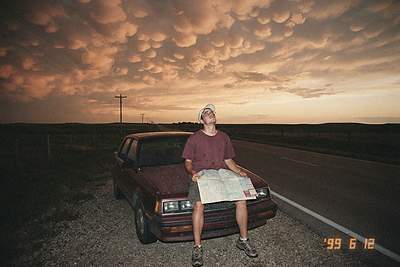
Saturday, June 12, near Pratt, Kansas.
The storm we chased fell apart, which made it a bust, but then the sun went down under the back of the anvil and lit up the
mammatus clouds. Those are the round pouches hanging down from the bottom of the anvil, where cold air is sinking. Kristopher is "looking
for our road home" in the atlas. He was not looking at the atlas.
WHAT'S A SUPERCELL?
A regular thunderstorm goes up, rains itself out, and dies in under an hour. A supercell is a thunderstorm with a deep, rotating updraft,
called a mesocyclone. Because the updraft is turning and tilted, the rain falls out to the side instead of right back down into it, so the
storm can keep going for hours. Supercells make the biggest hail, the worst wind, and most of the strong tornadoes. Not every supercell
makes a tornado. Most don't. But just about every big tornado comes from one.
THE GEAR
- A road atlas, and the state highway maps for Oklahoma, Kansas and Texas, marked up in pencil
- A NOAA Weather Radio, which picks up the National Weather Service broadcasts and the warnings
- The car's AM radio, for the local stations
- A notebook for the log, and a compass
- My 35mm, with the date back
- A cooler, a first aid kit, and a flashlight
- No laptop. We check the data in the morning in the weather lab at school and pick a target, then call from pay phones on the road
when we can. Mostly we just look at the sky. It's a good teacher.
OUR RULES
- Stay back. Far back. You see more of the storm from a distance anyway.
- Always have an escape route, a paved road going away from the storm, and know where it is before you need it.
- Never drive into the hail core. The heaviest hail is usually just north and east of the updraft. Don't go there. (Yes, we got hailed
on anyway. See above. It was not on purpose.)
- Get off the road for emergency vehicles. Pull all the way off. Never block a road. The people with sirens are the ones who matter.
- Never drive into water over the road. You can't tell how deep it is or if the road's still there. Flooding kills more people in
this country than tornadoes do. Turn around.
- No chasing after dark. You can't see what you're dealing with.
- Lightning is the one that'll get you. If you're standing outside next to a metal car under a thunderstorm, get in the car.
- Every storm we see goes in the log. Even the busts.
 |
MAY 3
We didn't chase on Monday, May 3. We had class. That evening we watched the coverage on TV in the dorm like everybody else in Oklahoma,
while the worst of the tornadoes went through Bridge Creek, Moore and the south side of Oklahoma City, a few miles north of us.
People died. Whole neighborhoods were gone. The Saturday after, May 8, Kristopher and I went up to Moore with a church crew and spent the
day hauling boards, insulation and pieces of people's houses to the curb. I found a little girl's photo album in a yard and gave it to a
lady who said she knew the family. I think about that more than I think about any storm I've seen.
I still want to study storms. More than ever, actually. But I don't cheer for tornadoes over towns, and I never will. The good ones are
over nothing.
|
 GeoCities.us
» ResearchTriangle » Field

 Willie's 1999 Storm Chase Log


