 GeoCities.us
» ResearchTriangle » Observatory
|
GeoCities.us
» ResearchTriangle » Observatory |
Get your FREE home page! |
 |

|
I have been an amateur astronomer since 1988. I've watched Jupiter's moons trade places from my back yard in Minneapolis, sketched the craters along the terminator on cold January nights with my 8-inch telescope, and seen a handful of partial eclipses, which are interesting the way a book report is interesting. What I had never seen was a total eclipse of the sun. Everyone who has seen one says the same thing: that nothing you've read prepares you, and that you should go. So this summer I went. I'm a hospital pharmacist, and I asked for the time off a year ahead, which my department head still brings up. This page is about the trip, the morning, and the two minutes in the middle of it. My pictures aren't much. I'll get to why. The Trip I went with an eclipse tour, twenty-six Americans led by Ted Clayborn, a retired high-school physics teacher from Wisconsin who had seen six total eclipses and talked about them the way some people talk about their grandchildren. My roommate was Janet Lafond, a librarian from Duluth, and by the end of the week we were finishing each other's sentences. There were three couples who had followed eclipses around the world for twenty years, a retired dentist with two video cameras, and Bill and Linda Kwong from California, for whom this was the fourth. I was one of the few first-timers. Ted called us "the rookies," which I would have minded more if he hadn't been so obviously happy for us. We flew out of Minneapolis on Sunday, August 8, through Amsterdam to Budapest, and spent two days there. It is a beautiful city, and I walked along the Danube at night with Janet and ate too much paprika and soaked in one of the old thermal baths, and all of it is a blur now, because all I could think about was the sky on Wednesday. The path of totality crossed Europe from Cornwall to the Black Sea and beyond, and Ted had chosen Hungary for the weather odds. On eclipse morning we took a bus west to Lake Balaton, a long, pale blue lake in the middle of the country, and up a hillside on the north shore to a small family winery, all vines and an old whitewashed farmhouse with a red tile roof and a huge walnut tree. The family had agreed to let twenty-six Americans stand in their vineyard and look at the sun. They seemed to think we were a little strange, and they were right. The Morning It was hot and clear, with a few small clouds early that made everybody nervous and then burned off. We set up between the rows of vines: tripods, telescopes, cameras, folding chairs, a cooler. I had brought too much. I had a 35mm SLR with a 500mm mirror lens on a heavy tripod for the sun, with a solar filter over the front, and a little point-and-shoot camera in my pocket for everything else, and a typed list of exposure settings taped to the tripod leg. Somebody had a shortwave radio, and late in the morning the news came through that Cornwall, where thousands of people had gone to see it, was clouded over, and so was much of western Europe. Ted just nodded and looked up at our perfectly blue sky and said, "That's why we came to Hungary." The Partial Phases The first contact came late in the morning: through the eclipse glasses, a tiny dark nick in the edge of the sun. Somebody cheered. Over the next hour the moon slid across the sun, bite by bite, and for a long time nothing on the ground seemed to change at all. Your eyes adjust. Then, maybe twenty minutes before totality, the light started going strange. It got dimmer, but not like a cloud; the colors went flat and silvery, and the shadows went sharp, sharper than they should be, every vine leaf drawn in ink on the dirt. It got cooler. The cicadas, or whatever they have in Hungary, stopped. 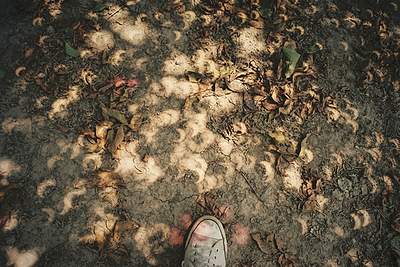 Under the walnut tree, about half an hour before totality. Every gap in the leaves is a pinhole camera, and every spot of sunlight is a little crescent sun. The sneaker is mine. Janet found these first, under the walnut tree by the farmhouse, and called everybody over. All the spots of sunlight coming through the leaves were crescents, hundreds of them, all pointing the same way. I knew this would happen, I had read about it a dozen times, and I still laughed out loud. Totality In the last minute, things happened very fast. Somebody shouted and pointed west, and you could see the shadow coming, a darkness moving across the far end of the lake and up the hills toward us faster than anything that big should move. The last of the sun shrank to a thin, bright line, and then to a few beads of light along the edge of the moon. Ted was counting down. And then it went out. Glasses off. You take your eclipse glasses off for totality, and only for totality, and you look straight up at the sun, and the sun is gone, and in its place is a black hole in the sky with the corona around it, pearly white, streaming out in long soft feathers on every side, much bigger than I expected. At the very edge of the black disk there were tiny pink flames, the prominences, so vivid they looked painted on. The sky around it was a deep, dark blue. Somebody behind me said "Oh my God" over and over, quietly. I think it was me. 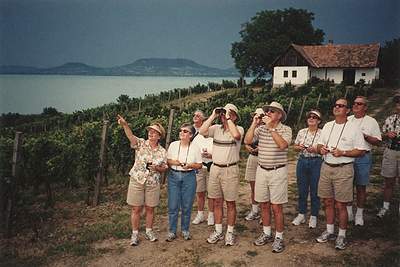 Totality, on the point-and-shoot. I turned around and took one picture of us instead of the sun. Linda Kwong is the one pointing. Nobody needed her to. It isn't dark, exactly. It's a twilight like no other. All the way around the horizon, in every direction, the sky was orange and yellow, like a sunset on all sides at once, because out there beyond the edge of the shadow the sun was still shining. The lake went the color of steel. The vineyard was all silhouettes, people standing with their arms in the air. 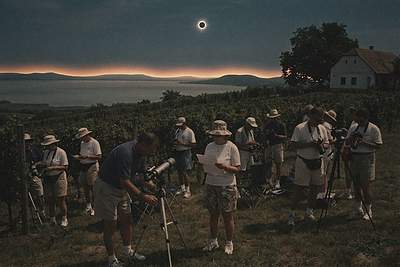 The twilight of totality: sunset all the way around the horizon, and the black sun overhead. The woman in front is Janet, reading the list she wrote to remind herself to look up. And here is my confession. I spent too much of those two minutes on the camera. I had a list of exposures to run through, and I ran through them, bending over the tripod, fiddling with the shutter speed in the dark, with the most beautiful thing I will ever see happening directly over my head. I kept telling myself to stop and look, and I kept taking one more. Ted had warned us. He said it every day on the bus: "Fewer cameras. More looking." I didn't listen. Then a bright point of light flared out at the edge of the moon, and Ted yelled "Glasses on!", and it was over. A little over two minutes, shortly before one o'clock in the afternoon, Hungarian time. That's all it was. 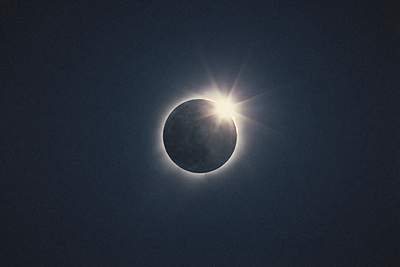 The diamond ring, the moment totality ended, through the 500mm lens. The one frame off my slide film I'm proud of. The rest of the roll is a lesson in being nervous. That flash is called the diamond ring: the first bead of sunlight coming back through a valley on the edge of the moon, blazing out against the last of the corona. It lasts a second or two. Then the light floods back, faster than it left, and the birds start up, and everyone is hugging people they met on Sunday. The People Around Me Janet cried, and then laughed at herself for crying, and then cried again. Bill Kwong, on his fourth eclipse, stood perfectly still the whole time with his hands in his pockets and his head back, no camera at all, and I've decided he's the wisest man I've ever met. The retired dentist got all two minutes on both video cameras and missed the whole thing. The winemaker's mother, a small woman in a dark dress who had come out to watch from the farmhouse step, crossed herself when it went dark and again when it came back. Afterward the family brought out bread and cheese and a few bottles of their own wine, and twenty-six Americans who had been up since four in the morning sat under the walnut tree and toasted the moon. Almost nobody watched the last partial phase. Ted did. What I'd Do Differently
Watching Safely
I've been home almost a month. I go back to work, I count pills, I look at Saturn on clear nights, and every so often, in the middle of a perfectly ordinary afternoon, I think about that black sun over the lake and I have to stop what I'm doing for a moment. Everyone was right. Go.     times since August 22, 1999. Were you in the path? I'd love to hear where you watched from. [email protected] Holly Seidman · Minneapolis, Minnesota Last updated Monday, September 6, 1999 |