GeoCities.us GeoCities.us » Route66 » Garage Get your FREE home page!


The Little Gem
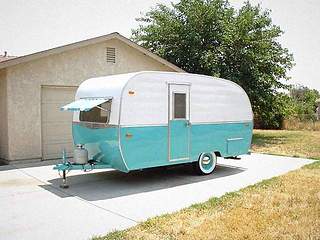
OUR 1957 CANNED HAM TRAILER
from $350 and a family of mice to our first campout, in sixteen months


The finished trailer in the driveway, turquoise below and white above, with a striped awning
She's done. August 21, 1999.

I'm Thomas Comer. I teach art at a high school in Fresno, California: drawing, painting, and ceramics, which means I spend my days covered in clay and my weekends, for the last sixteen months, covered in sawdust. My wife Cynthia manages a dental office, sews like a professional, and has the patience of a saint. This is the story of the Little Gem, a 13-foot travel trailer built in 1957 in the shape everybody calls a "canned ham," and how we brought her back. The maker's badge was long gone before we got her and I won't guess.

All the pictures are from my floppy-disk Mavica, which I bought in the spring of 1998 just in time and which also goes to school with me. Click a small picture for a bigger one.

STEP BY STEP

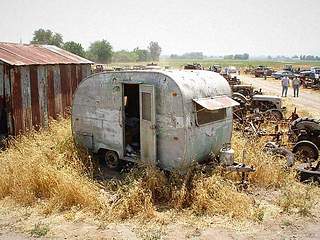
The faded old trailer sitting in dry weeds at the farm auction SATURDAY, MAY 16, 1998 · THE AUCTION
A farm auction south of town. Cynthia went for a sewing cabinet. I went along for the ride. Behind the shed, in the weeds, with a flat tire, faded to the color of an old dollar bill, sat this little trailer. Nobody else bid past $300. I said $350, and then I had to explain it to Cynthia. When we opened the icebox, a mother mouse and seven babies looked back at us. They were relocated to the field with full honors. We put air in the tire and towed her home behind the pickup at 35 miles an hour on the back roads.

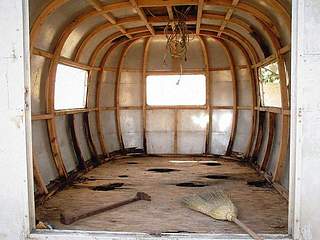
The inside of the trailer gutted down to its curved wooden ribs, with rot holes in the floor JUNE-JULY 1998 · GUTTING
Everything came out: the old paneling, the cabinets, the cushions, forty years of dust. The picture is from Saturday, July 11. You can see the problem. The ribs along the floor were rotten from a roof leak, the floor had holes I could put my foot through, and the wiring was old cloth-covered wire spliced with electrical tape. I sat on the step and thought about it for a long time.

AUGUST-OCTOBER 1998 · THE BONES
I traced each rotten rib on butcher paper, cut new ones from fir, and scarfed them in one at a time so the shape wouldn't change. New plywood floor, sealed underneath. Foil-backed insulation in the walls, which the original never had. Fresno in August is not the place to do this inside a metal box. I did it at 6 a.m.

NOVEMBER 1998 · THE WIRING
All new wire, a new fuse panel, proper outlets, and a heavy cord to plug in at a campground. A friend who's an electrician checked my work and only made me redo two things.

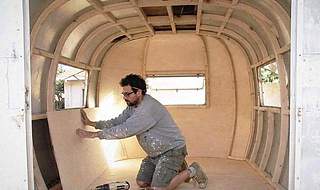
Thomas inside the trailer pressing a new sheet of pale birch paneling against the curved wall JANUARY-MARCH 1999 · BIRCH PANELING
Thin birch plywood, bent into the curves at the front and back. That's me on Saturday, January 23, pressing one into place while Cynthia takes the picture and tells me it's crooked. It wasn't. Then four coats of varnish. I left the ceiling ribs showing, varnished, because I like to look at them.

APRIL 1999 · STOVE AND ICEBOX
The original little two-burner stove and the icebox (a real icebox: you put a block of ice in the top) cleaned, re-plumbed and brought back. The stove got new gas line and a leak test. The icebox got a lot of bleach, for reasons mentioned above.

MAY-JUNE 1999 · THE SKIN
The aluminum skin patched where it was torn, polished where it would polish, primed and painted: turquoise below, white above, the trim strip between them polished until you could shave in it. Painting is my job, after all. I still took three tries on the turquoise to get it right.

JULY 1999 · CURTAINS AND TIRES
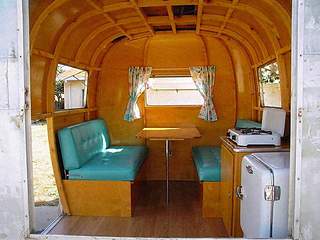
Cynthia found a bolt of 1950s print fabric at an estate sale, turquoise and coral boomerangs and starbursts on white, and sewed the curtains. Turquoise vinyl on the dinette cushions. New tires with whitewalls, new wheel bearings, new seals on every window.

The finished interior: birch walls, turquoise dinette, print curtains, a little white stove and icebox SATURDAY, AUGUST 21, 1999 · DONE
Fifteen months and a week after the auction. Look at that dinette! The table drops down and the dinette becomes a bed for two, if the two are friendly. The stove is on the right, with the icebox beside it.

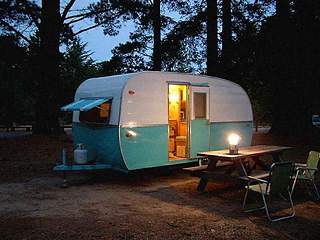
The trailer at a campsite under tall trees at dusk with a lantern lit on the picnic table LABOR DAY WEEKEND, SEPTEMBER 4-6, 1999 · FIRST CAMPOUT
Her first trip in who knows how many years: a state park campground on the coast near Morro Bay. It didn't leak, the stove worked, the icebox kept the ice for two days, and people walked over from other campsites all weekend to look inside. One man told us his parents had one just like it in 1959. We cooked pancakes on the two-burner and slept with the windows open and could hear the ocean. Worth every splinter.

WHAT IT COST
The trailer, at auction$350
Framing lumber and plywood floor$185
Birch paneling and varnish$310
Insulation$65
Wire, fuse panel, outlets, cord$140
Aluminum patches, rivets, primer, paint$295
Window glass and seals$120
Tires, wheels, bearings, hubcaps$210
Stove and icebox parts$85
Curtain fabric (estate sale)$18
Vinyl and foam for the dinette$160
Screws, glue, sandpaper, everything else$165
Total$2,103
Not counting sixteen months of weekends, one sprained thumb, and the sewing cabinet Cynthia didn't get.

WHERE TO FIND OLD TRAILER PARTS
  • Swap meets. Go early and bring cash. Look under the tables.
  • RV salvage yards. Most of what they have is newer, but ask about the back row.
  • Old-timers at trailer parks. Somebody always has a box of window cranks in the shed.
  • The classified ads, under "Trailers" and "Miscellaneous," every Sunday.
  • A man in Bakersfield with a barn full of old trailer windows. E-mail me and I'll tell you how to find him.
WHY SAVE A CANNED HAM?

Because there are fewer every year. Hundreds of little companies built them in the fifties and sixties, and most of those trailers have rotted in fields like ours almost did. They're small and light enough to tow with a pickup or a station wagon. They were built by hand, and you can fix one by hand. And as an art teacher I'll say this: that rounded shape, with the curve front and back and the little awning over the window, is the happiest shape anybody ever put on wheels. When you pull into a campground in one, people smile. You can't say that about a motor home.


Restoring one yourself? Have a question? I'd love to hear about it.
[email protected]


002240
visitors since June 1998 · Last updated September 12, 1999