 GeoCities.us
» SoHo » Studio
|
GeoCities.us
» SoHo » Studio |
Get your FREE home page! |
 |

|
The EaselCam A salt marsh at low tide, five feet by eight, painted in front of a camera Renee Heimbach · Savannah, Georgia 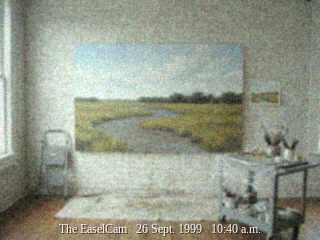 The easel wall, right now. A new picture every ten minutes from 8 a.m. to 8 p.m.; this page reloads itself every ten minutes. Sunday, September 26. Nobody home. I don't paint on Sundays; I go look at the real thing instead. What you see is about two-thirds of a painting: the sky is in, the trees are in, the marsh grass is in. The creek, that dull gray-brown S that winds back from the lower left corner, is only blocked in, and if your eyes are good you can still see my charcoal grid through it. The creek is this week's work, and the hardest part of the picture. I'm a landscape painter. For fifteen years I've painted the marshes around Savannah, mostly small pictures done outdoors or from outdoor studies, and two nights a week I teach drawing to grown-ups at a community art center. This summer I was given the biggest commission of my life: an oil painting five feet tall and eight feet wide of the salt marsh at low tide, for the lobby of a hospital's new wing here in town. It's due on Monday, November 15. The committee that chose me asked, half joking, if they could watch. So since Monday, July 26, the day I stretched the canvas, a little camera on a bookshelf across my studio has been taking a picture of the easel wall every ten minutes, seventy-three a day, and sending it here. The committee checks in. So, I've learned from my e-mail, do a surprising number of strangers, a fourth-grade class in Ohio, and my mother. The studio is an old brick carriage house behind my house, off the lane. The canvas hangs on cleats screwed into the whitewashed brick. The small picture pinned to the right of it is the study I'm working from. The gray cart is my palette, a sheet of glass on wheels. See also: the milestone frames, saved along the way. The diary, week by week Week 1. July 26 – August 1. Monday I stretched the linen over heavy stretcher bars with two crossbraces, which took most of the day and all of my patience, and gave it the first of three coats of gesso. Wednesday I snapped the grid on with a chalk line loaded with powdered charcoal. Thursday the drawing went on over the grid. Friday afternoon, the first color: the far tree line at the left and a pale wash low in the sky. Then I stood there with my arms folded for twenty minutes, which the camera saved for posterity. Week 2. August 2 – 8. Sky. The whole upper half blocked in thin, cerulean and white going warmer toward the horizon, with the clouds scrubbed in gray where they'll be. Week 3. August 9 – 15. More sky. Nobody believes how much paint a sky takes. Forty square feet of canvas and half of it is air. Week 4. August 16 – 22. Clouds, up on the step stool, arm over my head, for days. A thin first wash over the marsh, so I'd stop staring at white. Week 5. August 23 – 29. The tree line properly: live oaks, a few cabbage palmettos, the dark band where the hammock meets the marsh. Week 6. August 30 – September 5. The marsh grass begins. Thousands of short upward strokes, from the far edge forward. Week 7. September 6 – 12. Grass. I painted through Labor Day. The camera will tell you I took a long lunch. Week 8. September 13 – 19. Hurricane Floyd. On Tuesday we were told to leave, along with everybody else on the coast, and I spent most of the night on I-16 creeping toward my sister Tamara's in Macon, with the small study on the back seat and the big one on the wall under a drop cloth. The storm stayed offshore and we came home Thursday to a yard full of branches and nothing worse. The camera, which I forgot to turn off, sent a full day of pictures of a drop cloth. I lost three days and was glad that was all. Week 9. September 20 – 26. Finished the grass in the foreground. Friday I blocked in the creek. That's where it stands. Still to come: the creek and its mud banks, the shine on the water, small things at the far edge, and then the glazes, thin transparent layers over the whole picture to pull it together, each of which needs days to dry. I will make November 15. I have said this out loud, on the Internet. The palette Seven colors, the same seven I use outdoors. Everything in the painting is mixed from these and nothing else.
How a little picture becomes a big one The painting starts from a study ten inches by sixteen that I painted on the spot, at low tide, one morning this spring. Ten by sixteen is the same shape as five feet by eight. I drew a pencil grid over the study in one-inch squares, ten down and sixteen across, and snapped the same grid on the big canvas in six-inch squares. Then you copy what's in each little square into its big square, one square at a time, and the picture comes out six times bigger and in the right place. It's called squaring up. Painters have done it for five hundred years, and it feels like cheating every single time. Why it takes months People ask, so: forty square feet is a lot of canvas, and every stroke on it is made standing up or standing on a stool. Oil paint has to dry between layers, and the rule is fat over lean, thinner paint first and richer paint on top, or the picture will crack in ten years in a hospital lobby with my name on it. You can't see a painting this size from two feet away, so I paint a while and walk to the back of the room and look, all day long. And the glazes at the end each take days to dry. My small pictures take an afternoon. This one takes a season. The marsh at low tide At high tide the marsh is pretty. At low tide it's honest. The water drains out of the creeks and leaves the mud shining, the fiddler crabs come out by the thousands, the oyster shells show, the herons walk the edges, and the whole place smells of salt and sulfur and life. The creeks show their real shapes, the way they've wandered for a thousand years. I've stood at the edge of it in every season since I moved here, and I wanted a picture for a hospital that tells people something will still be going on, breathing in and out twice a day, whatever kind of day they are having inside. On being watched The first week was terrible. I wore a clean shirt. I stood where I thought I'd look like a painter. I caught myself not scratching my nose. I painted carefully, which is the worst way to paint. About the second Tuesday I got absorbed in a cloud and forgot the camera was there, and I've mostly forgotten it since. If you see me sitting on the floor eating a sandwich and staring at the wall, that's work too. If you see the studio empty after six on a Tuesday or a Thursday, I'm at the art center, teaching people to look at things. The particulars. The camera is a little one the hospital's computer people lent me, plugged into my own computer with a program that takes the picture and sends it here over the phone line. 8 a.m. to 8 p.m., every day, until the painting goes to the hospital. Then I'm going to unplug it and paint something small.     
Write to me: [email protected] Last updated Sunday, September 26, 1999 |