Saturday, October 12, 1996 — Found
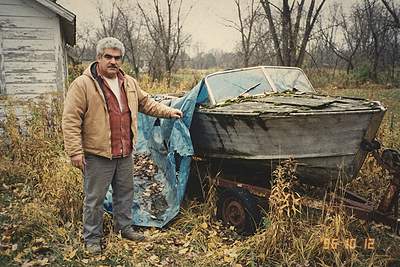
 There was a card on the bulletin board at the bait shop: OLD WOOD BOAT, MUST GO. A man was selling his
late father's cottage on one of the little lakes west of town, and the boat had been sitting behind it
under a tarp since about 1980. When I pulled the tarp back the wood was gray as a fence post, the varnish
was long gone, the windshield was cracked, and there was moss growing in the deck seams. The trailer tires
were flat and the trailer was rusted about halfway through. I said I'd think about it. Then I gave him
$800 before somebody else could. Anne asked what I paid and I told her. She asked what it would cost to
fix and I said "not much." This was my first mistake, but not my last.
Winter 1996-97 — Stripping the Bottom
 We got her home on the old trailer at twenty miles an hour with the flashers on. Out came the engine,
the seats, the windshield and every piece of hardware, into coffee cans on the shelf. Then my son Vincent,
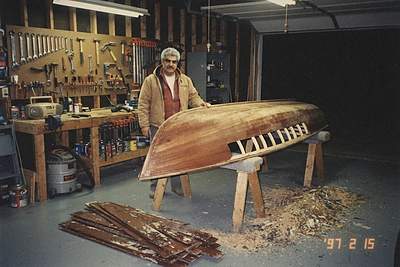
my friend Walter Newcomb from the shop, and I rolled the hull over onto padded sawhorses. I stripped the
old bottom paint with a heat gun and scrapers, and then started pulling the bottom planks. Some came off
in one piece. Some came off in a bucket. You can see the frames showing through near the stern, where the
worst of it was. This picture is from February 15, 1997. The pile on the floor was the old bottom, and
it was all firewood.
Winter 1997-98 — A New Bottom
I fished all summer and thought about it. When the weather turned I started on the new bottom: new
mahogany planks, each one fitted, bedded and fastened with silicon bronze screws. Bronze screws by the
thousand. I counted the first box and then I quit counting. Every screw hole gets drilled, countersunk
and plugged, and in a tool-and-die shop we'd call that a lot of operations for one part. Some of the frames
were soft and I added new ones alongside. In March 1998, with the bottom painted, Vincent, Walter and two
neighbors came over and we rolled her right side up onto a cradle on wheels. That spring the engine went to
a marine machine shop for a rebuild. No pictures of this winter, because the camera was in the house and
I was in the garage.
Saturday, November 21, 1998 — Sanding
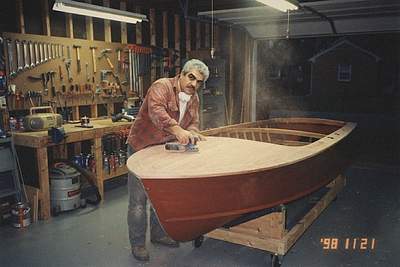
 The third winter was all about the sides and the deck, and that meant sanding everything to bare wood. I
went through sandpaper like a man goes through coffee. Anne came out to the garage and took this one. She
says that look on my face is the look I had for three winters. The dust gets in everything. It was in my
eyebrows, my coffee and, according to Anne, the living room.
December 1998 to April 1999 — Stain, Seams and 22 Coats
After sanding, a mahogany filler stain, wiped across the grain to fill it and bring up the color. Then
white seam compound in the deck seams, the thin white lines between the planks that make an old runabout
look like an old runabout. Then varnish. One coat, let it cure, sand it lightly, wipe it down, the next
coat. I did 22 coats over four months. People ask why 22. Because 21 didn't look right, and I wasn't going
to stop at 23 and spoil it.
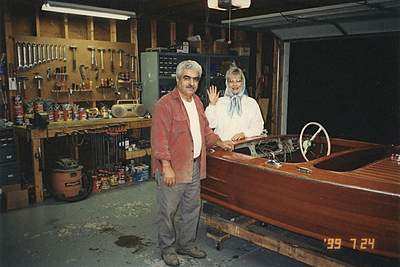
Saturday, April 10, 1999 — The Last Coat
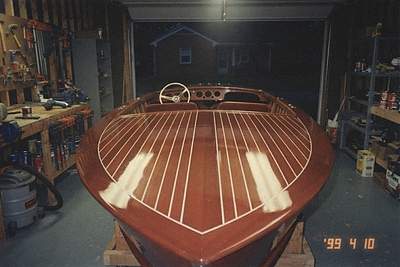
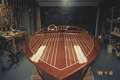 Coat number 22. The wheel and the dash were back in, the windshield and the deck hardware not yet. You
can see the shop lights in the deck. I stood in the garage with the door open and looked at it for a
long time. Anne came out with two cups of coffee and stood there with me and didn't say anything, which
is the nicest thing she said all winter.
May 1999 — Engine, Chrome, Seats
The six came back from the machine shop rebuilt and painted, and went back in. The hardware went out to be
rechromed and came back looking better than new. A shop in Racine did the seats in red, the way they would
have been. New wiring, the gauges cleaned up, new tires and bearings on the trailer. By Memorial Day she
was done except for the name on the transom, which I had lettered in gold. That's when I told Anne what
the name was going to be. That's the "reasons that will become clear."
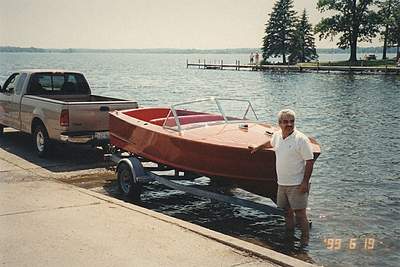
Saturday, June 19, 1999 — Launch Day
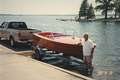 Lake Geneva, the public ramp, a little after eight in the morning. Walter backed my truck down, I stood in
the water, and Vincent took the pictures. She slid off the trailer and floated, and I'll be honest, I had
to look at the trees for a minute. A wooden boat that's been out of the water for twenty years leaks
until the planks swell up tight, so we tied her to the dock for an hour and let her drink. Then the engine
started on the second try, and Anne and I took her out.
 GeoCities.us
» SouthBeach » Marina