GeoCities.us
» Tokyo » Market
|
GeoCities.us
» Tokyo » Market |
Get your FREE home page! |
 |

 Kiong Hee Huat Tsai!

|
Kiong Hee Huat Tsai! That's how we say Happy New Year in Hokkien, the Chinese we speak at home. It means "congratulations, and may you prosper." On New Year's Day you say it to everybody you meet, and if you are a child, you say it especially to every grown-up who might be holding an ang pao. (More about ang pao below. The children would want me to put it first.) I'm Carmen Tan. I made this page because every year our Filipino friends and our foreign friends ask me the same questions: What do you eat? Why the lettuce? What is that sticky thing in the red box, and what do I do with it? So here are the answers, with pictures from our New Year 1999 at my mother's place in Binondo. Herminio, my husband, took them with his camera, and our daughter Frances showed me how to make a page. I started it in February. It is now September. A hardware store and two children will do that to a promise. On this page: What is a Tsinoy? · The Rabbit · The reunion dinner · Ang pao · The lion and the lettuce · Papa · How to fry tikoy
Tsinoy is Tsino (Chinese) plus Pinoy (Filipino). That's us: Chinese-Filipinos. We were born here, we grew up here, we complain about the traffic here, and at New Year we do things the way our parents and grandparents did. My father came from Fujian in 1948. He was sixteen years old, and he came to work in his uncle's store in Binondo, Manila's old Chinatown. He swept floors, counted nails and learned Tagalog from the customers. In 1956 he opened a store of his own, a hardware store, and in 1958 he and Mama moved into the flat upstairs. That's where Celso and I grew up, over the paint cans and the coils of rope. Papa died in 1994. Mama is 74 now and she still lives upstairs, as she has since 1958, and she still comes down every morning to check the cash box. My younger brother Celso Yao, who is 38, and I run the store now. We are not allowed to touch the cash box until Mama has seen it. We have never asked why. I was born Carmen Yao. I married Herminio Tan, who is 43 and an accountant, and we live in San Juan with our children, Frances, 13, and Jake, 9. They go to a Chinese school, and they speak Hokkien with their grandmother, English with their cousins and Tagalog with everybody, sometimes all three in one sentence. To the children my mother is Ama, which is Hokkien for grandmother. (To our Filipino friends: yes, I know, in Tagalog ama means father. The children think this is the funniest thing in the world.) I still call her Mama. Like many Tsinoys, we are Catholic. Mama hears Mass at Binondo Church, where San Lorenzo Ruiz, the first Filipino saint, was an altar boy. He was canonized in 1987, and his father was Chinese, which Mama will tell you herself if you stand still long enough. And every morning she also burns incense for Papa at the family altar upstairs. Both. Every day. Mama sees no problem, and in our family, what Mama sees is what there is. Chinese New Year follows the Chinese calendar, so the date moves around. This year it fell on Tuesday, February 16, 1999. It is not a holiday in the Philippines. But in Binondo it might as well be.
This is the Year of the Rabbit. Mama says a Rabbit year is gentle, careful and lucky. Gentle and careful I can do. Lucky I'll take. I keep the zodiac talk to that, because once you start, everybody at the table wants to know their animal, their children's animal, and whether the two of them will get along, and then dinner is cold. Please don't write to ask me what your animal is. I sell nails.
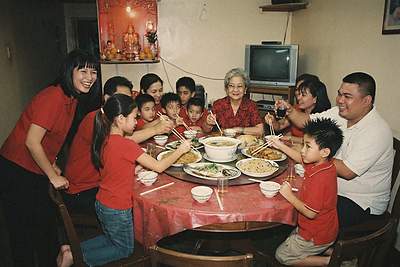
New Year's Eve is for family. Everybody comes home to Mama's for the reunion dinner, at the big round table with the lazy Susan in the middle. This year we were twelve: Mama, Celso with his wife and their three, Herminio and me and our two, and Mama's younger sister and her husband. A round table, Mama says, because nobody sits at the head and nobody sits at the foot. The lazy Susan has one rule: turn it slowly, because somebody on the other side is in the middle of reaching for the lumpia. What we eat, and why, as Mama explains it every single year:
Then, at midnight, the whole street goes off: firecrackers in front of every store, smoke so thick you can't see across, and the next morning the street is red with paper. The children hold their ears and refuse to go inside. Mama goes to bed at a quarter past twelve, every year, and says she slept through it, every year.
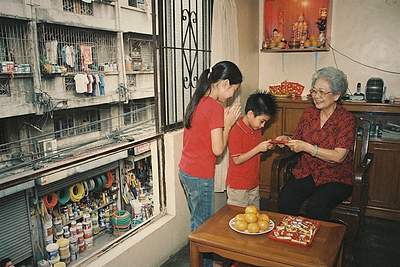
Ang pao is the little red envelope with money inside. Red is for luck, and the money inside is for luck too, the children will tell you, but mostly for spending. On New Year's morning the children greet their grandmother first thing: hands pressed together, a little bow, and "Kiong Hee Huat Tsai, Ama!" Then Ama gives each one an ang pao. In the picture you can see Mama in her old wooden armchair in the sala (that's the living room), Frances doing it perfectly, and Jake already reaching for his envelope before he has finished saying it. On the little table there's a plate of oranges and a tray of candies, and out the window, the shops across the street with their buckets and hoses hanging out. Ang pao manners, the Yao family rules:
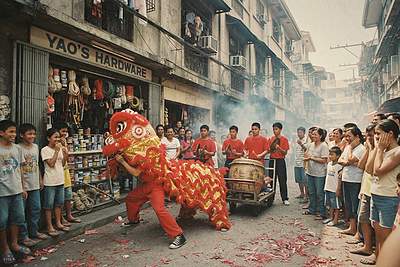
On New Year's Day the store opens late. Around noon you hear it before you see it: drums, gongs and cymbals coming up the street. It's the lion dance troupe from one of the Chinese associations in Binondo, and they go store by store. Every store on the street waits for them with its doors open, because a store the lion skips is a store with no luck. In the first picture, that's our store, with Papa's name on the sign: Yao's Hardware. The lion is red and gold and white, with a long shaggy body, and it's crouching and shaking its head right in front of our shelves of paint and rope. Behind it are the drummers, all in red, with the big drum on a cart. The neighbors' children are lined up along our storefront, the grown-ups are watching from the other side, and the smoke is from the firecrackers. Look at the red paper all over the street. Nobody sweeps on New Year's Day. Mama says you'll sweep your luck out the door. (The children like this rule very much.)
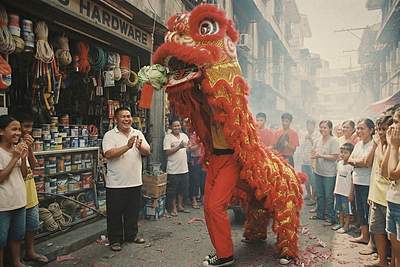
Now, the lettuce. Before the lion comes, Celso hangs a head of lettuce and an ang pao over our door. The lion dances in front of the store, works itself up, goes for it, and "eats" the lettuce and the ang pao, for good luck in business for the whole year. Everybody cheers. The lion goes off with the ang pao, and the store has its luck. The second picture is the moment it got it: the lion with the lettuce right in its mouth, and Celso in front of the store in his white polo, clapping like a man who has just been told the year will be very good. The children along the storefront are clapping too. You can see the bins and shelves of the store behind him, if you want to know what a hardware store in Binondo looks like. It looks like everything you ever needed, in no order anybody but Mama understands.
When I was a little girl, Papa was always the first one up on New Year's morning. He put on the new shirt Mama had pressed for him the night before, went down to the store with the shutters still closed, and sat at his desk in the half dark with a cup of tea, putting new bills into ang pao, one envelope at a time, and counting every one twice. Then he came upstairs and woke Celso and me by saying "Kiong Hee Huat Tsai!" louder and louder until we said it back. He hung the lettuce himself, standing on an empty nail crate from the store. When the lion came, he lifted me onto his shoulders so I could see, and I remember holding on to his ears. He never clapped. He just stood in the doorway with his hands behind his back and smiled, as if the lion had come all that way for him personally. The first New Year after we lost him, nobody remembered the lettuce until we heard the drums down the street. Celso ran for a nail crate. He has hung the lettuce every year since, standing on a crate, and every year I think he looks a little more like Papa. I have never told him that. Maybe he'll read it here.
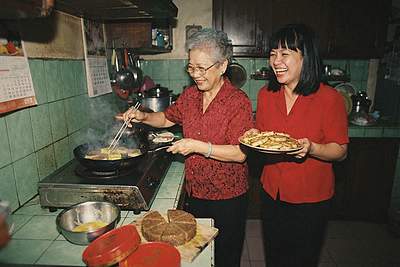
Tikoy is the sticky New Year cake, a round brown cake of sweet sticky rice that comes in a round red box. Everybody gives everybody tikoy. Our store gives a box to each of our suki (our regular customers, some of them since Papa's time) and to our Filipino neighbors, and of course everybody gives us tikoy back. By the end of New Year's week, our refrigerator is tikoy from top to bottom. Mama says it's sticky so the family sticks together. Herminio says it's sticky so the dentists have a happy new year too. The picture is from the Sunday before New Year: Mama at her old two-burner stove in her little green-tiled kitchen, frying with her chopsticks, and me with a plate of fried ones, laughing because she had just told me I eat them faster than she can fry them. Which is true. On the counter you can see the bowl of beaten egg, a tikoy already sliced on the board, and the red boxes still waiting. Yes, it was February 14. Valentine's Day. Herminio took my picture in my mother's kitchen. Very romantic. How to fry tikoy, Mama's way:
That's our New Year. If you're in Binondo next New Year's Day, follow the drums. If you hear a lot of cheering in front of a hardware store, that's us. Come in and say Kiong Hee Huat Tsai to Mama. She'll check if you're married. Carmen |


 What is a Tsinoy?