Five Colors and a Ladder
Painting Our Galveston Victorian, March to August 1999
by William Krull · photographs by Lynn Sevigny
In 1996 Lynn and I left Houston, where we had lived for twenty years, and bought a little house in
the East End of Galveston. I had just retired after thirty-four years adjusting insurance claims, which
is an education in what happens to houses, and Lynn plays the organ at a church here on the island. The
house is a one-and-a-half-story Queen Anne cottage built in 1895, which means it came through the Storm
of 1900, the hurricane that killed at least six thousand people on this island on the night of
September 8 of that year. It has been through a good deal since, and it has been painted plain white
since about 1965.
This spring and summer we gave it back its colors. Five of them. This is how, step by step, for
anyone with an old house and a ladder, and for our friends in Houston who keep asking "so what color
did you end up with?" The answer is: yes.
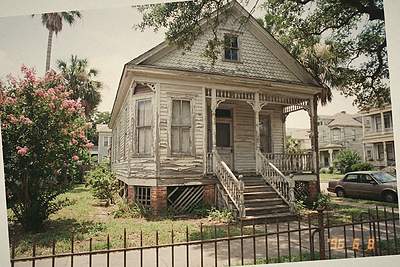
June 8, 1996, the day we made our offer. Lynn took this from the sidewalk while I was still saying "it has potential."
|
1. Lead first
Any house painted before 1978 has probably got lead paint on it somewhere, and an 1895 house has a
hundred years of it. In March we chipped off three small pieces down to the bare wood and sent them to
a testing lab. All three came back with lead in the lower layers. That decided how we would do
everything else:
- Scrape wet. Mist the surface with a spray bottle of water before you scrape, so the chips
fall instead of the dust flying.
- Never dry sand, never use a power sander, a heat gun or a torch on old paint. That's how lead
gets into the air and the soil.
- Lay heavy plastic on the ground and the porch floor under where you're working, taped down,
and fold it up carefully at the end of each day. Bag the chips and wipe up with damp rags. We rented a
special vacuum with a HEPA filter for the cleanup.
- Wear a real respirator with HEPA filter cartridges, not a paper dust mask.
- Keep children and pets away from the work and the chips. Wash your hands and face before you
eat, and wash your work clothes separately.
Our cats, Tosca and Figaro, were kept indoors from March until August, and the neighbors'
grandchildren were asked very nicely to play on the other side of the street.
2. Scraping
Every weekend and most weekdays in April and May. The porch was mine: the turned posts, the railing,
112 balusters, 212 spindles in the frieze, and eight jigsawn brackets, every one of them with thirty
years of white paint in the curls.
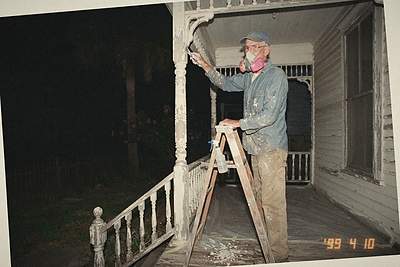
April 10, after supper, under the porch light. Lynn said come down and eat. I said one more bracket. Note the spray bottle and the plastic on the floor.
|
3. Repairs
Scraping shows you everything. We dug out and redid the old putty in every window and replaced two
cracked panes. Twenty-two porch floor boards were soft and came up and new fir went down. Three
spindles had split and a bracket was missing altogether, and a woodworker in Houston turned three
spindles and cut a bracket to match the old ones for less than I'd feared.
4. Choosing the colors
Lynn found a book at the library of exterior color schemes from the 1880s and '90s, reproduced from
the paint company catalogs of the day, and we spent the month of April arguing over it at the kitchen
table. Houses like ours were never white. The Victorians liked deep, earthy colors, several on one
house: one for the body, one or two for the trim, the window sash darker than all of them, and an
accent to pick out the carving. We chose six candidates, threw one out, and in May brushed test patches
two feet square of the other five right on the clapboards, side by side, and looked at them morning,
noon and evening for two weeks.
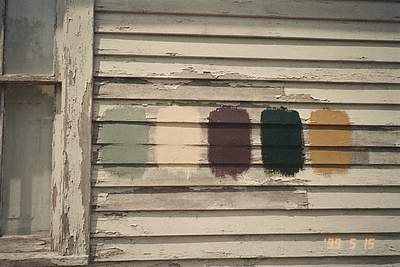
May 15. Left to right: sage, cream, plum, bottle green, gold. We kept all five.
|
Here is where each one went:
| | Sage green, the body. All the clapboards, and the fish-scale shingles in the gable. |
| | Cream, the first trim. Corner boards, window and door casings, porch posts, railing, balusters and spindles. |
| | Plum, the second trim. The rails of the porch frieze, the edges of the brackets, and the cornice. |
| | Bottle green, the sash. Very dark, nearly black. The darkest color always goes on the sash; it makes the windows look deep. |
| | Gold ochre, the accent. Only on the little round cut-outs and rosettes in the brackets. A small brush and a steady hand. |
5. Primer and paint
Oil-based primer on every bit of bare wood, then two coats of good exterior latex. We did the body
from the ground and the porch from stepladders. The front gable we left to a professional painter with
a lift, who did it in four days in June and made it look easy, which it is not. The spindles alone took
Lynn and me all of July, one color at a time.
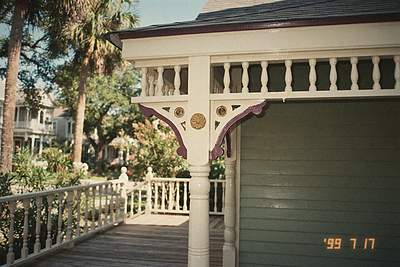
July 17. Cream post and spindles, plum rails and bracket edges, gold rosette and cut-outs. There is a drip on the third spindle. I know.
|
6. Done
The last of the gold went on August 21. A week later Eugene Hampton across the street took our picture
on the steps.
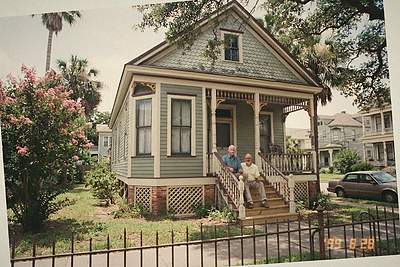
August 28, 1999, from the same spot on the sidewalk as the first picture. That's me on the left and Lynn on the right. The house looks like itself again.
|
What it cost
| Item | Cost |
| Lead test, three paint chips to a lab | $45.00 |
| Two respirators and spare filter cartridges | $64.00 |
| Plastic sheeting, tape, spray bottles, heavy trash bags | $83.00 |
| HEPA vacuum rental, six weekends | $90.00 |
| Scrapers, blades, putty knives, wire brushes | $47.00 |
| Glazing putty, glazier's points, two panes | $38.00 |
| Fir porch boards and lumber | $186.00 |
| Three spindles and a bracket, made to match | $96.00 |
| Oil-based primer, 9 gallons | $171.00 |
| Paint: 7 gal. sage, 4 cream, 2 plum, 1 bottle green, 1 qt. gold | $345.00 |
| Brushes, rollers, 24 tubes of caulk | $112.00 |
| Painter for the front gable, with his lift | $1,150.00 |
| Total | $2,427.00 |
Not counted: our labor, about five months of weekends; one pair of bifocals, stepped on;
and iced tea, by the gallon.
What the neighbors said
Mrs. Rosemary Hammel next door, who has lived on this street since 1949, brought over a pound cake
the day the painter's lift drove away and said she'd been waiting thirty years for somebody to do that.
Vickie Conlon two doors down asked for the color names on a piece of paper and is now scraping her own
porch, God help her. Eugene Hampton took our picture. Mrs. Shirley Claudio around the corner liked it
white, and tells us so, very kindly, every single morning on her walk. That's the vote: all for it but
one.
A word from the cats
Tosca (the gray tabby, on the railing in the last picture) and Figaro (black, under the bed) were
shut indoors from March to August for their own good, and wish it to be known that they have not
forgiven anyone.
Visitors to our porch since June:
    

Questions about old houses, lead or color are welcome:
[email protected]
Last updated Sunday, September 12, 1999
|
 GeoCities.us
» WestHollywood » Heights

