 GeoCities.us
» Yosemite » Campground
|
GeoCities.us
» Yosemite » Campground |
Get your FREE home page! |
 |

|
Through the Blowdown The Boundary Waters, August 16-20, 1999 · by Mark McDaniel (and Valerie) I have paddled the Boundary Waters Canoe Area Wilderness every summer since 1975, when my college roommate Loren Hellman and I borrowed a canoe and got lost for a week and loved every minute of it. I teach shop (woods and metals) at a high school in Rochester, Minnesota, and the summers are what make the school year possible. This was trip number twenty-five, and the first one with my daughter Valerie, who is fourteen. It was also six weeks after the windstorm of July 4th. I had been on the phone with friends up north all July, and I thought hard about postponing. In the end we went, and I'm glad we did. I don't expect to see anything like it again. The Storm Monday, August 16 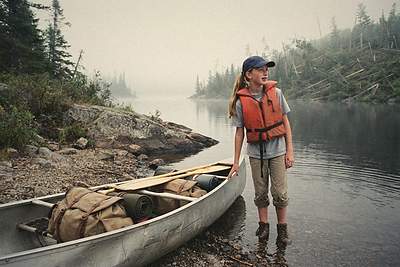 We put in at an entry point at the end of a road east of Ely a little after seven, in a mist so thick we couldn't see the far shore, or any shore. Valerie held the canoe while I loaded the packs. That's my old 17-foot aluminum canoe, which I bought used in 1977 and which has more dents than I have gray hairs. Look behind her, on the right: even at the landing you could see the first broken trees. We paddled by compass until the mist burned off around nine, did three short portages, and made camp on an island by three in the afternoon. Valerie went to bed at eight-thirty and didn't say a word. That's how I knew she had worked hard. Tuesday, August 17 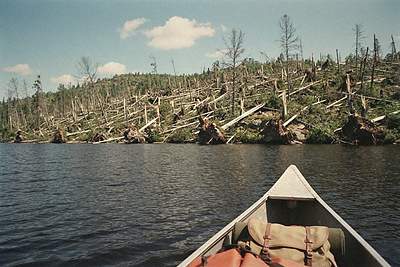 This is the day we got into the heart of it. I took this from the stern with the bow of the canoe in the corner. A whole hillside, trees two feet thick, snapped off ten feet up or torn out roots and all, and every one of them lying the same way, like somebody had combed them. Upturned roots holding boulders the size of a car. A few trees left standing, stripped. We paddled a mile of shoreline like that and neither of us said much. What I remember most is the smell. The whole country smelled like fresh-cut pine, like my shop at school, because it was all fresh-broken wood and sap. And it was quiet. Usually the woods along a lake are full of small sounds. Where the trees were down, there was just the wind and the water. Wednesday, August 18 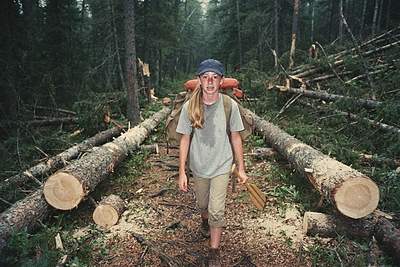 The long portage, about a mile, and the one I had worried about most. The crews had been through. You walk down a corridor cut through the fallen trunks, the sawn ends on both sides of you as high as your waist, fresh sawdust on the trail. In places the trail went over and around root mounds where it never used to go. Without the crews, I don't think we could have gotten through at all. Valerie carried a full pack and a paddle every step without one complaint, which I want on the record, because I am going to remind her of it later. 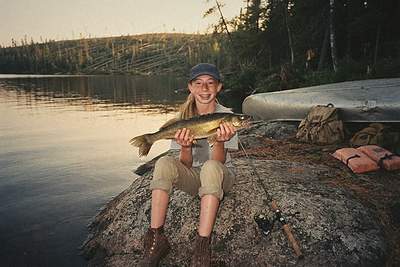 That evening, from a rock point off our campsite, Valerie caught her first walleye on a jig and a leech: nineteen inches, a beautiful fish. She did it all herself while I was getting the stove going, and I heard about it before I saw it. We fried it in the cast-iron pan in cornmeal and ate it with rice, and she has told everybody we know about it since. The blowdown is right there in the background, across the bay. Thursday, August 19 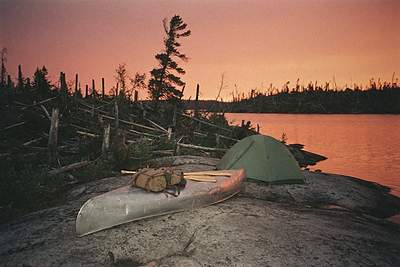 A layover day. No portages, no packing up. We slept late, swam off the rocks, read, fished a little, and watched the sky. Our campsite was on a granite point, and the crews had cleared it, but most of the big trees around it were down. One tall pine was left standing on the point, and we decided it was the toughest tree in Minnesota. That night the loons called back and forth across the lake for an hour. Valerie said it was the best day of the trip, and I agreed. Friday, August 20 Up early, packed, and out by noon. A burger and a malt in Ely, and five hours of Valerie asleep in the passenger seat with her feet on the dashboard.
What We Brought
Fishing Notes
If You're Going Call the Forest Service before you go and ask about closures, campsites and portages along your route. Things were still changing week to week when we went. Plan short days. Getting around downed trees takes longer than you think, and some campsites are gone or not as you remember them. Above all, be careful around the standing trees that were damaged. A lot of them are hanging on by a thread, and in any kind of wind I wouldn't camp under one.  Visitors since August 29, 1999:    Questions about the trip, or the canoe country? Write me at
[email protected] |