 GeoCities.us
» Yosemite » Ridge
|
GeoCities.us
» Yosemite » Ridge |
Get your FREE home page! |
 |

 MARK'S SERVICE PROJECT The Bridge Over Beaver Creek Project write-up by Mark, age 16 | Pennsylvania | Summer 1999 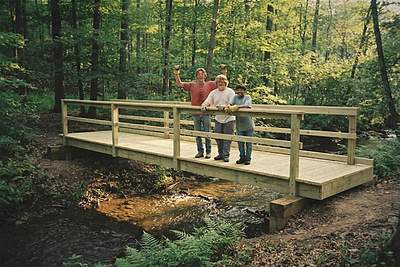 Done! Saturday, August 14, 1999, about 5:30 p.m. That's me with my arms up, Brendan in the white shirt, and Roy. This summer I built a 24-foot wooden footbridge over Beaver Creek on the nature trail at our county park. It was my service project, which is the last big thing I need for the top rank in my troop. Our troop leader, Jeffrey, said I should write it all up while I still remembered everything, and my dad said if I was going to write it up anyway I might as well put it on the Internet. So here it is. It's laid out the same way as the project workbook, because after six months of filling that thing out, that's how my brain works now.
WHAT THE TOP RANK TAKES People keep asking me this, so:
SECTION 1. PROJECT DESCRIPTION The county park has a two-mile nature trail that goes in a loop through the woods, and about halfway around it crosses Beaver Creek. As long as I can remember, the way across was a big old log. Last winter it finally broke in the middle and one half sank into the creek. After that you either waded across or turned around and went back, and the school groups that come out to the park every spring couldn't do the whole loop. The park naturalist had "bridge at Beaver Creek" on her list of things the park needed and no money in the budget for it. My dad heard about it, I'd been looking for a project since my birthday, and that was that. 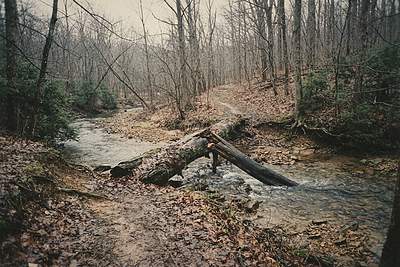 The old crossing, Saturday, March 20, 1999, the day we measured. You can see why nobody was using it.
SECTION 2. PLANNING Measuring. On Saturday, March 20, my mom and dad and I walked out to the creek with a 50-foot tape and a notebook and measured everything: the width of the creek, the height of the banks, where the solid ground was. Remember this part. It comes back in Section 5. The plans. I drew them on graph paper, one square equals six inches, a side view and a top view. Here's the design in words:
Approvals. In April it went to the park first (the naturalist and the county parks office), then my troop committee, then the district. Every one of them signed off in the workbook. The district asked if the county would take care of the bridge after I was done, and the county said yes in writing. Money. We held a car wash on Saturday, May 22, in a church parking lot, from 9 to 3. We asked $4 a car or whatever you wanted to give. A lot of people gave $10, and one man gave $20 and told us to skip his car. We made $648.00.
SECTION 3. MATERIALS AND COST The lumberyard gave us 10 percent off all the lumber because it was a community project. The prices below are what we actually paid.
Tools were all borrowed: two circular saws, three cordless drills, ratchet wrenches, shovels, a digging bar, a come-along, rope, and every pair of work gloves in the troop.
SECTION 4. CARRYING IT OUT Day 1: Saturday, July 17, 1999. We met at the trailhead parking lot at 7:30 in the morning. Edward had picked up the lumber with his pickup and trailer the night before. The creek is about a quarter mile down the trail, so first we carried everything in. The stringers were the worst. A wet treated 4x12 that long weighs a ton, or it feels like it, and it took six of us on each one, switching shoulders every hundred feet. Then the dads pulled the old log out of the creek with the come-along and rope, and we dug the seats for the sills in both banks, filled them with crushed stone and set the sills. Then we set the stringers, and that's when we found out about the foot. (See Section 5.) We finished the day with the stringers in place at about 6. 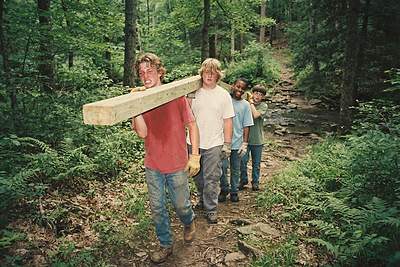 Hauling lumber in from the parking lot on Day 1. Me in front, then Brendan, Roy and Melvin. I'm not mad, I'm concentrating. Day 2: Saturday, July 31, 1999. The decking. It rained until about 10, so we started late and worked until 4. The dads ran the circular saws on sawhorses at the end of the bridge and cut the 2x6s in half, and the rest of us carried them out and screwed them down. 54 boards, two screws into each of the three stringers, so 324 screws, not counting the ones Melvin dropped in the creek. Roy found most of them. Day 3: Saturday, August 14, 1999. Posts, rails and cleanup, starting at 8:30. Every post got two carriage bolts through the outside stringer, which means drilling a half-inch hole eight inches through treated wood 28 times. We burned through two drill batteries an hour. Then the rails, then we hauled every scrap of wood and every screw back out to the parking lot, raked the trail, and stood on it. 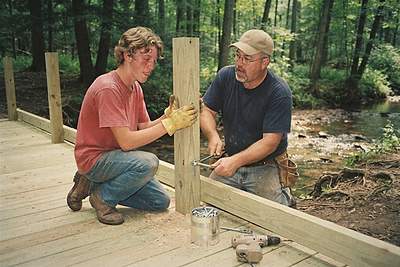 Dad and me bolting on a post, Day 3. Two done on this side, five to go. He's explaining something. He's always explaining something. Hours (the workbook wants them):
(People counts include me. Hours are minus lunch. Fourteen different volunteers came at least once.)
SECTION 5. PROBLEMS AND WHAT I LEARNED The stringers came out a foot short. This is the big one. On Day 1 we set the first stringer on the near sill, walked it across, and the far end hung in the air about a foot short of the far sill. All three of them. What happened: back in March I measured the creek right where the old log crossed, because that's where the trail went. But on Day 1, when we got down there, the naturalist and the dads agreed the bridge should go about ten feet upstream, where both banks were higher and solid instead of muddy and caved in from people climbing around the log. That was the right call. The problem is nobody measured again, including me, and ten feet upstream the creek is a foot wider. So the stringers were a foot short, and you can't exactly take a 26-foot 4x12 back to the lumberyard. The fix: we dug the far sill back out and cut a new seat for it a foot closer to the water, in a bank full of tree roots, with a digging bar. It took most of the afternoon. The bridge ended up on solid ground with a full foot of bearing on each end, so it all worked out. But I lost most of a day and everybody knew whose fault it was. Lesson: measure where the bridge is actually going to go, not where the old thing was. And measure twice. Dad says that's the oldest rule in carpentry, and now I know why it's the oldest. Rain. Day 2 started three hours late. Nothing to do about that except bring a tarp for the lumber. Screws in the creek. See Day 2. Keep the screw boxes in the middle of the deck, not on the edge. Leading people is harder than building things. The workbook says you have to lead, not just do the work yourself. The first morning I kept grabbing a shovel and Jeffrey kept taking it away from me and telling me to go figure out what everybody else should be doing. By Day 3 I had a list on a clipboard and everybody had a job before they got out of the car. That's probably the thing I actually learned this summer.
SECTION 6. THANK YOU The guys from my troop: Brendan, Roy, Melvin, Alexander, Andrew, Perry, Brock, Joseph and Beau. My mom, who took all the pictures, brought sloppy joes on Day 1 and pizza on Day 3, and drove me to the
lumberyard about nine times.
WHAT'S NEXT My board of review is Tuesday, October 12. I bring the workbook and talk about the project and everything else. I'm nervous. Dad says just tell them what happened, the foot included. I'll put up how it went. And if you're ever at our county park, walk the whole loop now that you can, and when you get to Beaver Creek, jump up and down in the middle. It doesn't move. I checked.     Questions about the bridge or your own project? E-mail me: [email protected] Last updated September 19, 1999 |