 GeoCities.us
» Heartland » Plains
|
GeoCities.us
» Heartland » Plains |
Get your FREE home page! |
 |

|
GREAT BEND WxCAM West edge of Great Bend, Barton County, Kansas · looking west-southwest, the way the weather comes |
|
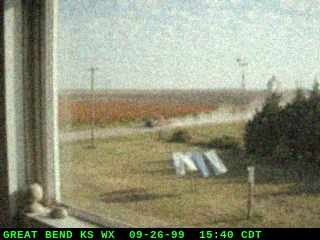 New picture every 2 minutes, first light to 10 p.m. Hit Reload for the latest. |
CURRENT CONDITIONS SUN 09/26/99 3:40 PM TEMP OUT ........ 81 F HUMIDITY ........ 34 % DEW POINT ....... 50 F WIND ............ S 15 MPH HIGH GUST TODAY . 27 MPH BAROMETER ....... 29.86 IN FALLING RAIN TODAY ...... 0.00 IN RAIN SEPTEMBER .. 1.41 IN RAIN 1999 ....... 22.63 IN |
|
[ The view | Dark or stuck? | The station | Greatest Hits | Storm Log ] Howdy, and thanks for stopping by. My name is Kent Stampley. I carry rural mail out of the Great Bend post office, a 112-mile route through Barton County, and I've been a trained SKYWARN storm spotter since 1986. Between the two I spend most of my life looking at the sky, so I put a camera in the window and now you can too. This afternoon is about as nice as late September gets out here. South wind at 15, warm, a little hazy, and the milo across the road has turned that rusty red that means it's about ready to cut. Joan's towels are out on the line and I'd say they'll be dry in about twenty minutes. THE VIEW The camera sits on the sill of the west window upstairs, in the spare bedroom, which Joan has quit calling the spare bedroom. It's the weather office now. We live in a two-story farmhouse built in the 1920s on the west edge of town, and from up there you can see a long way. Closest in is our back yard: the clothesline, the rain gauge on its post, and the 20-foot mast with the wind cups and the vane on top. The row of cedars on the right is our windbreak. Past the yard is the gravel road and the power line, then fields clear to the horizon, and that white elevator standing up way out on the right. The white strip down the left edge is the window frame, and the knickknacks on the sill are Joan's. They stay. It faces west-southwest on purpose. In this part of Kansas that's where the weather comes from, and I'd rather see it coming. IF IT'S DARK OR STUCK The camera takes a new picture every two minutes from first light until 10 p.m. After that it quits for the night and the last picture just sits there until morning. When there are storms around, I leave it running all night, and those are the nights worth staying up for. If it's daytime and the time in the bar along the bottom is old, the phone line dropped or the computer hung up. I'm usually out on the route until the middle of the afternoon, so it may be a while before I can fix it. It'll be back. THE STATION
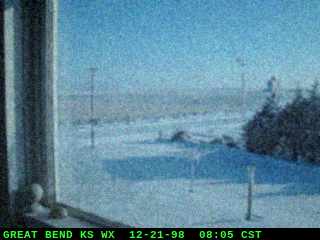
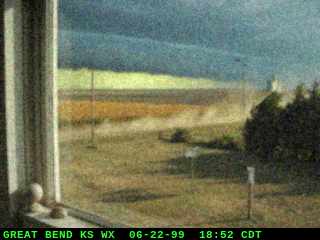
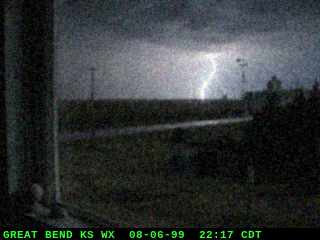
The camera writes over its own picture every two minutes, so if I want to keep one I have to be quick about it. These three I'm glad I caught. |
 |
|
Monday, December 21, 1998, 8:05 a.m. The morning after six inches of snow, and the sky already clearing off to that hard winter blue. Not a track on the road yet. It drifted in along the cedars the way it always does. I had to carry that day anyway. Rural carriers don't get snow days. |
 |
|
Tuesday, June 22, 1999, 6:52 p.m. A shelf cloud rolling in at suppertime, dark blue-black and stretched across the whole horizon, with that strange green-yellow light underneath and the dust already blowing off the road. The wheat was still standing in the sun, about ready for harvest. Five minutes after this frame my anemometer caught a gust of 64 miles an hour. I called it in. Then I went down and made sure the storm cellar door would open. |
 |
|
Friday, August 6, 1999, 10:17 p.m. One frame out of thousands. The camera takes one picture every two minutes and a lightning bolt lasts a blink, so the odds of catching one are just about nothing. I've left it running on every stormy night since the storms started up this spring, and this is the only one I've got. It came down just to the left of the elevator, a long way off. Joan says it's the best picture on the Internet. She may be biased. A WORD FOR SPOTTERS If you live out here and you've ever wanted to learn to spot, the Weather Service puts on free spotter training in the spring, county by county. Watch the paper for when it comes to yours. It's a couple of hours in a school gym or a fire station, and you'll never look at a cloud the same way again. Spotters are the eyes on the ground. Radar can tell you a lot, but it can't tell you what's actually on the ground under that storm. Our daughter Rachel lives in Salina now with her husband, and she checks this camera to see what's headed her way. So far I've given her about an hour's notice every time. That's what it's for. |


