The FeederCam
Dixie and Fred Stewart's back yard, on the hill outside Ithaca, New York
A new picture every five minutes, 7 in the morning to 6 at night, Eastern time.
Press Reload (Refresh, if you have Internet Explorer) for the newest one.
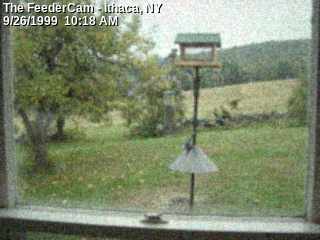
Sunday morning, the 26th: the little dark spot on the pole just above the
baffle is our white-breasted nuthatch, who goes down the pole headfirst the way nuthatches do. The
goldfinches had just left. They always leave just before the picture is taken. I've timed it.
Hello, and welcome to our back yard. I'm Dixie Stewart. I kept the books for a farm-supply co-op for
thirty-one years, and when I retired I found I couldn't stop counting things, so now I count birds.
My husband Fred carried mail out of the Ithaca post office for thirty-four years and built the feeder you're
looking at, in our garage, in the spring of 1987. The shingles on its roof are left over from the
garage. It has outlasted the garage roof and a deck.
The FeederCam was our grandson Scott's idea. He's a sophomore at Cornell, twenty years old and
very patient with us. Over Thanksgiving weekend last year, on the Friday, he put Windows 98 on our
computer (that took the whole morning), put a little camera on the dining-room windowsill, and
taught me how to look at our own back yard on the Internet. Our daughter in Rochester checks it every
morning with her coffee. So do people in eleven states and two provinces, who write me about what they
see. I love every letter.
The camera looks out through the window glass, so you'll see a bit of the window frame at the bottom
and sometimes a reflection of the dining room. I will not have Fred cutting a hole in the wall. The tube
feeder and the suet cage hang by the kitchen door, out of the picture.
Who's at the Feeder This Week
Monday, September 20 through Sunday, September 26, 1999. "Most at once" is the most of that
bird I saw at one time, so I don't count the same chickadee forty times. That's how Project FeederWatch
at the Cornell Lab of Ornithology taught me to count. I've counted for them every winter since 1991,
November to April, and I'll start again in November.
| Bird | Most at once | Remarks |
| Blue Jay | 6 | Carrying sunflower seed off to bury. Fall business. |
| American Goldfinch | 9 | Gone olive-drab for winter already. |
| Black-capped Chickadee | 4 | |
| Mourning Dove | 5 | On the ground, cleaning up after everybody. |
| House Finch | 3 | |
| White-breasted Nuthatch | 2 | Upside down, as usual. |
| Tufted Titmouse | 2 | |
| White-throated Sparrow | 2 | First of the fall, Thursday the 23rd. |
| Downy Woodpecker | 1 | At the suet. |
| Gray squirrel | 1 | Houdini. Every day. Not a bird, but he eats like three. |
No juncos yet; they usually come back to us in October. The last hummingbird went through
on Tuesday the 14th. See all 41 birds we've had since 1987 on our Yard List.
The FeederCam's Best Pictures
The camera only takes one picture every five minutes, so any bird that holds still long
enough to be in one deserves a place on the page.
| Saturday, December 5, 1998, 9:41 a.m. · Houdini |
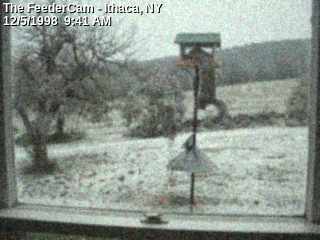 Our nemesis, one week into the FeederCam. Fred's baffle on the pole works perfectly, and Houdini
knows it, so he doesn't bother with the pole. He runs out along the apple tree, jumps to the feeder roof
and hangs over the edge to eat, like a man at a circus. Fred has cut that branch back twice. The squirrel
has not noticed. |
| Thursday, January 14, 1999, 8:12 a.m. · The Cardinals |
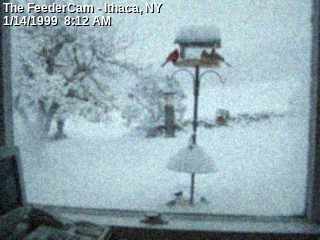 Snowing hard, and the hill behind the yard gone clean away. That's the male in red on the left end
of the tray and his wife in brown on the right, and a junco down in the snow by the pole. We've had a pair
of cardinals every winter since the feeder went up. I don't suppose it's been the same pair all these
years, but I like to think so, and nobody can prove otherwise. |
| Thursday, March 18, 1999, 2:36 p.m. · Number 41 |
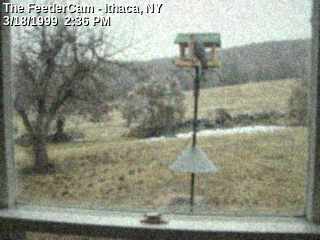 Look at the empty yard first. There had been thirty birds out there. Then look at the gray shape
on the feeder: a Cooper's hawk, the first one we've ever had, and the forty-first bird on our Yard List.
I saw him from the kitchen, long banded tail and all, and ran for the binoculars. He sat on Fred's feeder
for about eleven minutes, which is two pictures, and didn't catch a thing. I was rooting for the
chickadees, but I can't say I wasn't thrilled. |
How the FeederCam Works
- The camera is an Intel Create & Share camera that plugs into the back of our Compaq
Presario. It sits on the dining-room windowsill, about ten feet from the feeder.
- A program called Webcam32 takes a picture every five minutes from 7 a.m. to 6 p.m.
and sends it to this page. Scott set it all up. I only know how to turn it on.
- We put in a second telephone line so the FeederCam doesn't tie up the phone. My sister
in Elmira had been getting a busy signal for a week before we figured that out.
If the Picture Is Dark or Old
After 6 at night the camera stops and you'll see the last picture of the day until
morning. In December it's dark here by half past four, so the last few pictures are black. That's
night, not trouble. Look at the date and time printed along the bottom of the picture: if it says
yesterday in the middle of the day, the computer has hung up the phone and nobody's noticed yet. Fred
checks it after lunch. If it's white, it's snowing. We do get snow.
Visitors to our back yard since Thanksgiving 1998:
    
Please write and tell me what you saw, or what's at your feeder:
[email protected]
[ Our Yard List ]
Last updated Sunday, September 26, 1999
|
 GeoCities.us
» RainForest » Jungle